Six cities, and the difference between them is not decorative.
We are a Phoenix pool repair referral service. Tell us what's wrong and we'll connect you with a local pool repair company.
Water hardness across this list runs from an average of 10 grains per gallon in Gilbert to 25 in southern Scottsdale, and the median year a home was built runs from 1984 in Tempe to 2003 in Gilbert. Those two numbers between them decide most of what goes wrong with a pool here, and roughly when.
So there are six pages, not thirty. Each one carries the figures that city publishes for itself, with a link to where they came from. Pick yours below.
The number is (602) 833-7014 if you would rather talk. The form gets you to someone faster.
The six cities
Every one of these is a link, and every one of them has its own numbers on it.
The biggest and the oldest — half the housing stock predates 1985, and five treatment plants on three different rivers mean the fill water is not the same on both sides of town.
Read the Phoenix pageThe hardest fill water of the six, and it changes by street: 22–25 grains south of Indian School Road, 16–18 north of Chaparral. Scale is the recurring bill here.
Read the Scottsdale pageIts own city, its own water utility, and a hardness figure Mesa itself reports as a range — 12 to 22 grains, depending which supply reaches your street.
Read the Mesa pageThe newest pools and the softest water of the six. A median 2003 build means a lot of Gilbert pools are hitting their first resurface and first equipment change together.
Read the Gilbert pageThe oldest housing of the six and the widest hardness swing anywhere here — 10.4 to 32.6 grains, because the Salt and Verde river blend changes with the season.
Read the Tempe pageThree separate supplies feed Chandler, and the city says so: 5 grains at one end, 20 at the other, averaging 16.5. Which one reaches your street decides your scale rate.
Read the Chandler pageThree things, regardless of which of the six cities you are in.
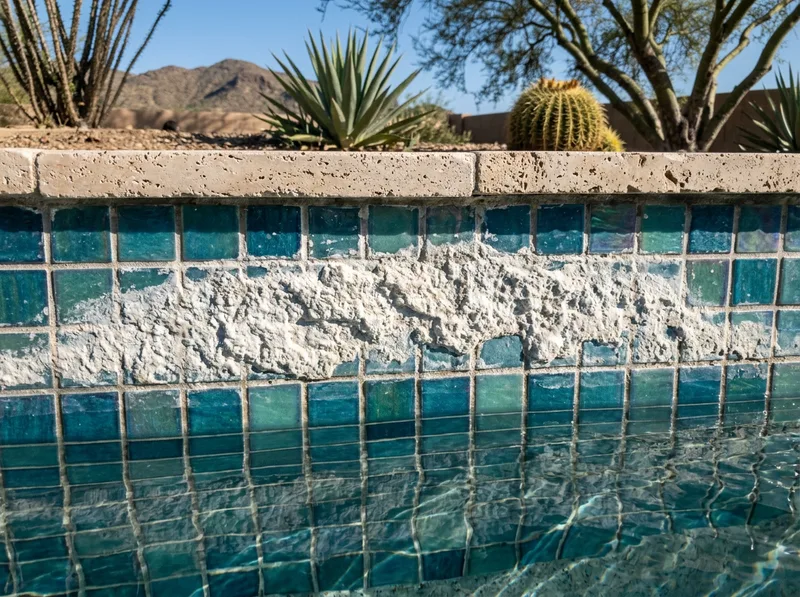
The water is hard everywhere. Even Gilbert, the softest supply on this list, averages 10 grains per gallon, and Scottsdale's southern band reaches 25. Calcium scale on the tile line, inside a gas heater's heat exchanger and on a salt cell's plates is the background cost of owning a pool in the Valley, and almost all of it is invisible until something stops working. What a repair visit actually covers starts there more often than not.
The monsoon is a real event with real dates. The National Weather Service defines the season as June 15 through September 30, and states that monsoon thunderstorms can cause damaging winds, torrential rainfall, frequent lightning and dust storms. For a pool that means debris load, a filter working far above normal, and occasionally physical damage to equipment. It is also the season when pools go green fastest, because a filter that cannot keep up and water at swimming-pool temperatures in August is all algae needs.
And summer hides leaks. Evaporation is fast enough that a genuine leak can pass for a hot week for an entire season, and an autofill will hide it for longer than that by removing the only symptom you would have noticed. That is why a real leak search is worth doing rather than arguing about.
Yes, with detail worth knowing. A.R.S. §36-1681 applies to any contained body of water 18 inches or more deep and wider than 8 feet. It requires a barrier of at least five feet measured from the outside, with no opening through which a four-inch sphere can pass, and gates that are self-closing and self-latching, open outward from the pool, and have the latch at least 54 inches above the ground.
Two exceptions in the statute matter here. It does not apply to a pool or barrier built before the article took effect — relevant in Phoenix and Tempe, where the median home predates 1986. And it stands aside where a city has adopted its own ordinance that is equal to or more stringent, which is why the city page is the right place to check rather than the state one.
The moment this becomes urgent is a drain. A drained pool with the gate propped open for equipment access is the exact situation the law exists for, and it is when a barrier is most likely to be looked at. If that is where you are, flag it as urgent on the form rather than booking a normal visit.
Because a page that is another city's page with the name swapped is worth less than no page at all — to a reader and to a search engine. Writing six pages that each say something specific and true is harder than generating thirty, and it is the only version worth publishing.
It also means each page can carry its sources. Every hardness figure on this site comes from that city's own water utility, every build-year figure from the same Census table, and both are linked at the bottom of the page they appear on. You can check any of it.
The cap has a second effect worth being honest about: there are Valley cities with real pool demand that are not on this list. That is a deliberate trade. A page written properly about six cities beats a thin page about sixteen, and the list can grow later when there is something specific to say about the next one.
If your pool is somewhere else in the Valley, the form still works. Choose "somewhere else in the Valley" and describe the problem; we will pass it on the same way. Nothing about the six-city list limits who we can put you in front of — it limits what we are willing to publish a page about.