What counts as a pool emergency in Phoenix?
Three things genuinely cannot wait, and it is worth being clear about them because paying an out-of-hours premium for something that can wait is money thrown away.
- Anything electrical. A breaker that trips and will not stay on, a burning smell at the equipment pad, scorched or melted plastic, or any tingle or shock from pool equipment, handrails or the water itself.
- The smell of gas near a heater. This is a gas utility call before it is a pool call.
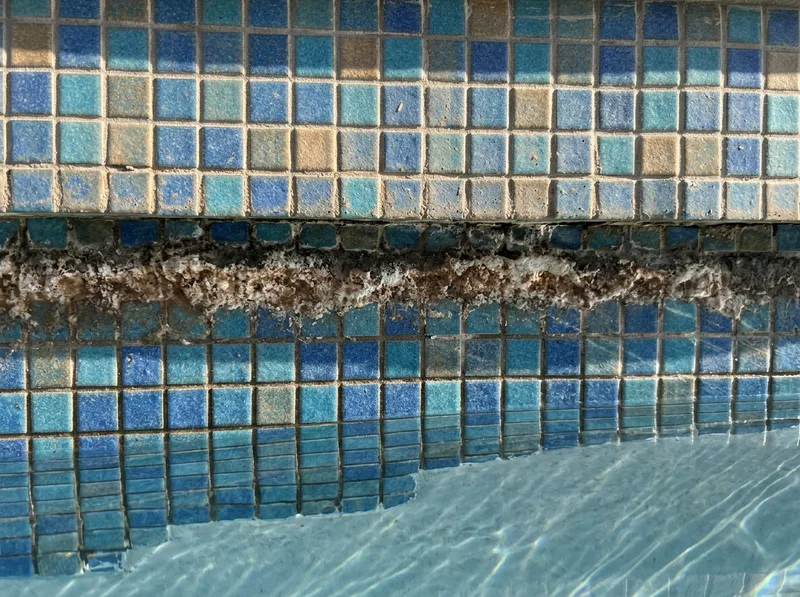
- Fast water loss. Inches a day, not a fraction of an inch. Water escaping under a pool can undermine the shell and the deck, and the pump is at risk of running dry while it happens.
Everything else — a dead heater, a green pool, a noisy pump, a torn filter element — is worth fixing quickly and is not an emergency. If you can safely switch the affected equipment off and nothing is getting worse, waiting for normal hours is a reasonable, cheaper decision.
One exception worth naming, because it is the one that catches people: a pump that is running dry or pulling air gets worse every hour it stays on. That is a small repair on Saturday morning and a bigger one on Sunday night.
Your Phoenix pool is losing water fast — do these three things now
In this order, and all three are free:
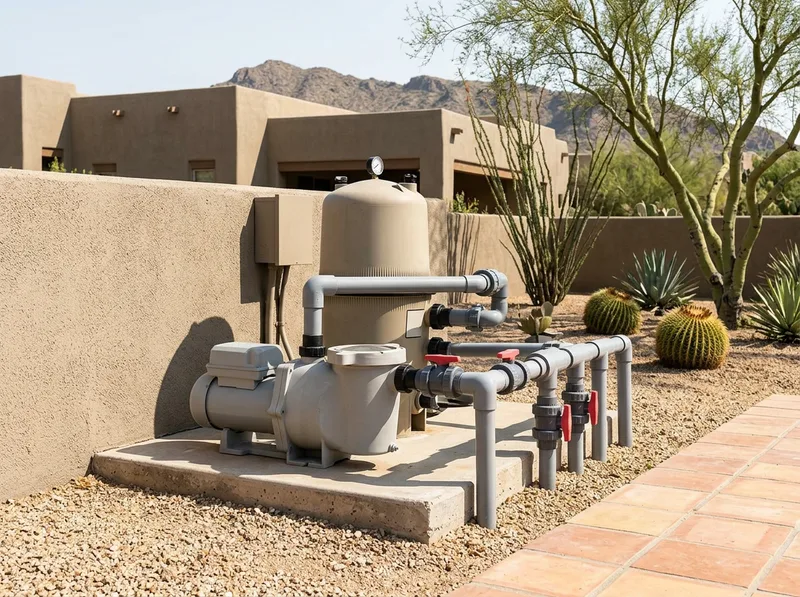
- Switch the pump off. If the leak is on the pressure side of the system, the pump is what is pushing water out of it. Turning it off can slow a fast leak to a trickle immediately, and it protects the pump from running dry.
- Switch the autofill off. Otherwise you cannot see how fast you are actually losing water — AMWUA notes that an autofill can hide a leak entirely by topping the pool up as it drains.
- Mark the water level and note the time. A pencil line on the tile and a time is the single most useful piece of information you can hand a repair company. “Two inches in six hours” gets triaged differently from “it seems low”.
Do not let the water drop below the skimmer opening with the pump running. A pool pump that runs dry will destroy its shaft seal and can crack the housing, turning a leak into a leak plus a new pump.
Once things are stable, the free two-day test on our leak detection page will tell you whether you are looking at a genuine leak or a very hot week. For scale: the City of Phoenix states that a leak of one inch a day can waste up to 100,000 gallons a year, which is enough to fill a typical pool four times.
When to switch off the breaker
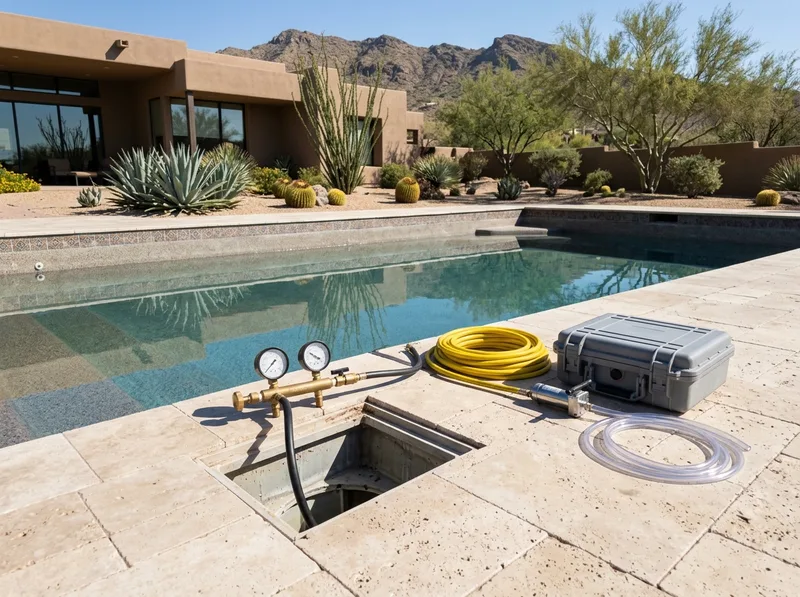
If anything electrical is involved, go to the panel, switch off the pool equipment breaker, and leave it off until someone qualified has looked at it. That covers a breaker that keeps tripping, a burning or hot-plastic smell, visible scorching at the equipment, water pooling where the electrics are, or any shock from pool equipment.
Do not keep resetting a breaker that trips. A breaker that trips repeatedly is working correctly — it is detecting a fault — and forcing it back on removes the only thing standing between that fault and a fire. A motor that hums, runs hot and trips is a classic Phoenix failure, and it is covered properly on the pump and motor page.
If anyone has felt a shock in or around the water, keep everybody out of the pool until it has been inspected. That is not a wait-and-see situation.
If you smell gas near the pool heater
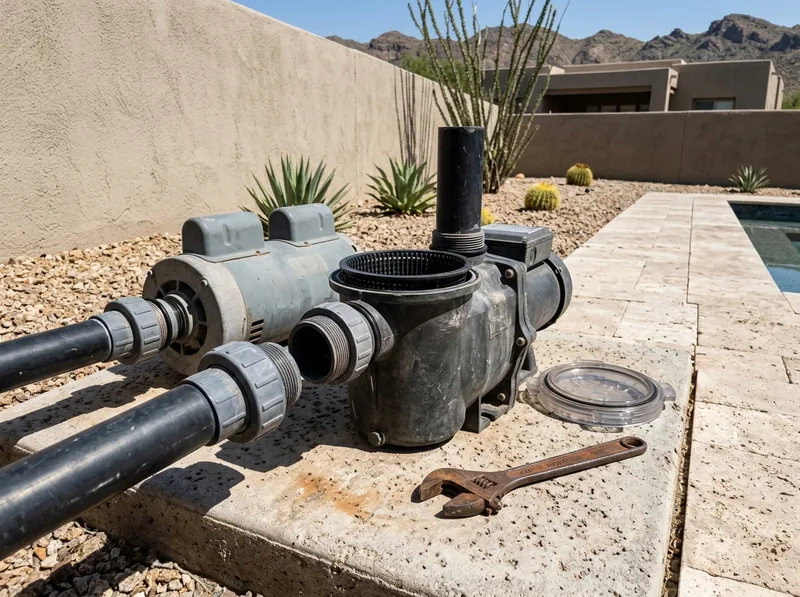
Treat it as a gas emergency, not a pool problem. Move away from the equipment. Do not switch anything on or off nearby, and do not try to relight anything. Call your gas utility, and call 911 if you believe anyone is in danger.
A pool repair company is the right call afterwards, for the heater itself. It is not the right first call, and any pool website that tells you otherwise is writing marketing copy rather than safety advice. Once the gas side is dealt with, the heater repair page covers what typically fails and what it is worth fixing.
Can you actually get same-day pool repair in Phoenix?
Sometimes. We are not going to promise it, because we would be promising on behalf of a company whose schedule we do not control, and anyone guaranteeing you a slot before they know what is wrong is guessing.
What is worth knowing is the shape of the local market. The Phoenix pool company that currently ranks top for pool repair publishes hours of Monday to Friday, 7am to 4pm, and no after-hours or emergency service anywhere on its site. That is fairly typical here. It means a Saturday failure often waits for Monday by default rather than by decision, and it means being early in the queue matters more than it would in a market full of 24-hour operators.
Which is the practical advice: send the inquiry as soon as the equipment is safely off, rather than waiting until Monday to start looking. And say plainly that it is urgent, with the detail to back it up.
What does an out-of-hours callout cost in Phoenix?
We do not know, and we are not going to make a number up. We have no signed contractor, so we have no rates of our own, and out-of-hours pricing varies by company in a way that no published range would represent honestly.
What we can tell you is what to ask. Before anyone comes out, ask for the callout fee, whether it is credited against the repair if you go ahead, the out-of-hours rate specifically, and whether the visit includes diagnosis or just attendance. Those four questions take a minute and they are the difference between a bill you expected and one you did not.
For general market context on repair prices — pump work, heater work, resurfacing — the figures published by local companies are collected on our Phoenix pool repair page. They are attributed, and none of them are ours.
And to be explicit about our side of it: the inquiry costs you nothing, we do not add anything to your repair bill, and we do not take a percentage of it.
What to send us so a Phoenix company can triage it fast
A company can triage a detailed message in about thirty seconds. A vague one goes to the bottom of the pile, not out of malice but because they cannot tell whether it needs a truck or a phone call. Include:
- What is happening, in plain words — what you can see, hear and smell.
- What you have already switched off, and when.
- If water is dropping: how much, over how long.
- Any error code on a heater or pump display, copied exactly.
- Your city, and a number you will actually answer.
- The word “urgent”, if it is.
We cover Phoenix, Tempe, Chandler, Scottsdale, Mesa and Gilbert. If it is faster to talk, call (602) 833-7014, or use the contact page. Send us a message any time.