Is your Phoenix pool leaking, or is it just evaporation?
This is the whole question, and almost every other decision follows from it. In a Phoenix summer, an uncovered pool loses a real, visible amount of water to evaporation every single day. Wind, low humidity, water temperature and how much the pool gets used all move that number, which is why “it seems like more than usual” is not evidence of anything.
You need a control — something sitting in the same sun, the same wind and the same heat as the pool, that cannot possibly be leaking. That is what the bucket test gives you, and it is why it works when eyeballing the tile line does not.
It is worth knowing how common the answer “yes” is. The City of Phoenix Water Services department states that about one in 20 pools leak. That is not most pools. It is also not rare enough to dismiss.
How do I run the bucket test on a Phoenix pool?
These are AMWUA’s steps, not ours. They publish them for exactly this purpose and the method costs nothing:
- Turn the autofill off, if you have one. This matters more than anything else on the list.
- Stand a bucket on a pool step, without letting it submerge. Weigh it down with a rock or a brick so it cannot float or tip.
- Fill the bucket so the water inside it sits level with the pool water.
- Mark the water level inside the bucket, with tape or a water-soluble marker.
- Mark the pool water level on the outside of the bucket.
- Wait at least two to three days to let natural evaporation happen.
- Compare the two marks.
If the pool level (the outside mark) has dropped further than the water inside the bucket, you have a leak and it is worth calling someone. If both dropped by the same amount, that was evaporation and your pool is fine — turn the autofill back on and stop worrying about it.
One refinement worth adding: run the test once with the pump running its normal schedule, and if the result is ambiguous, run it again with the pump off. A leak that only shows up when the pump runs points at the pressure side of the plumbing or at the equipment itself, which is a different search from a leak in the shell.

How much water does a leaking pool waste in Phoenix?
More than the size of the drip suggests, which is the reason small leaks are worth chasing rather than living with.
An inch a day is not dramatic. On a full-size pool you would struggle to spot it against a busy weekend of swimming. It is also, on the city’s own figures, four poolfuls of water a year.
AMWUA frames the smaller end the same way: even a small leak “can waste hundreds of gallons each week, raising your water bill and putting extra pressure on local water supplies”. And it notes that outdoor water use can make up as much as half of a household’s water bill during the hottest months — which is precisely why a leak hides inside a Phoenix summer bill without ever looking like a leak.
Why an autofill hides a pool leak for months
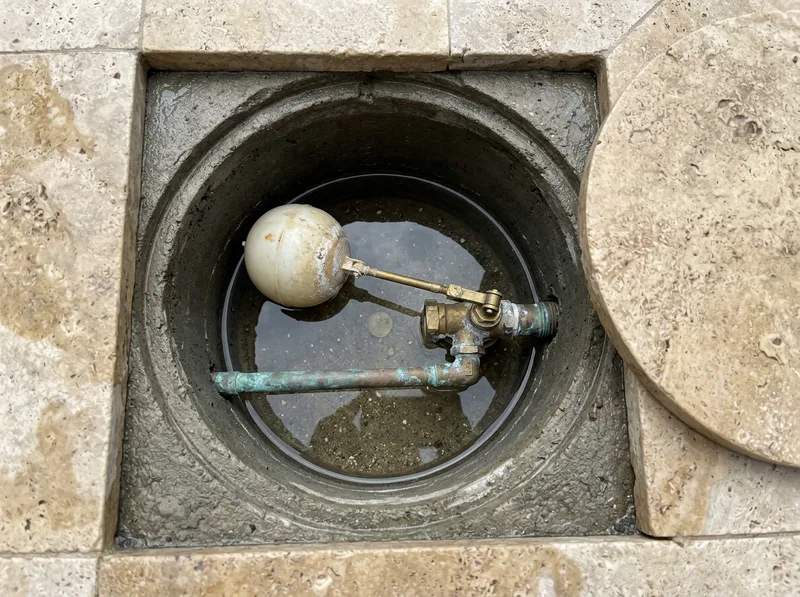
This is the most useful thing on this page and almost nobody mentions it. AMWUA states it directly: an autofill “can hide a leak by automatically adding water, so you may not notice the level dropping”.
Think about what that means. The device whose entire job is to keep your pool level constant will keep it constant whether the water is leaving through evaporation or through a crack in a return line. The pool looks perfect. The tile line never moves. The only symptom is on the water bill, and a rising summer water bill in Phoenix looks exactly like a Phoenix summer.
So if your bill has climbed and you cannot account for it, the first move is free: turn the autofill off and watch the level for a few days. If the level starts dropping in a way it never appeared to before, the autofill was covering for something.
Where do pool leaks happen, and what are the warning signs?
Leaks live in three places, and each announces itself differently.
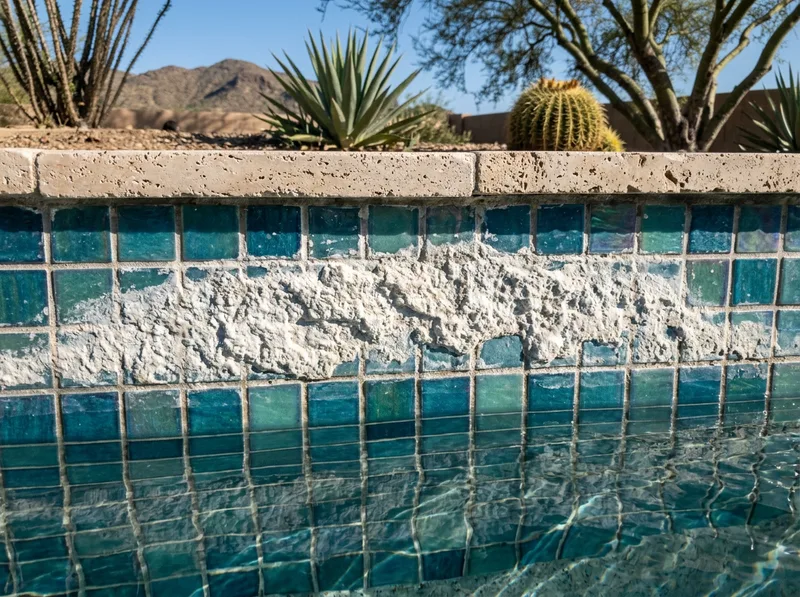
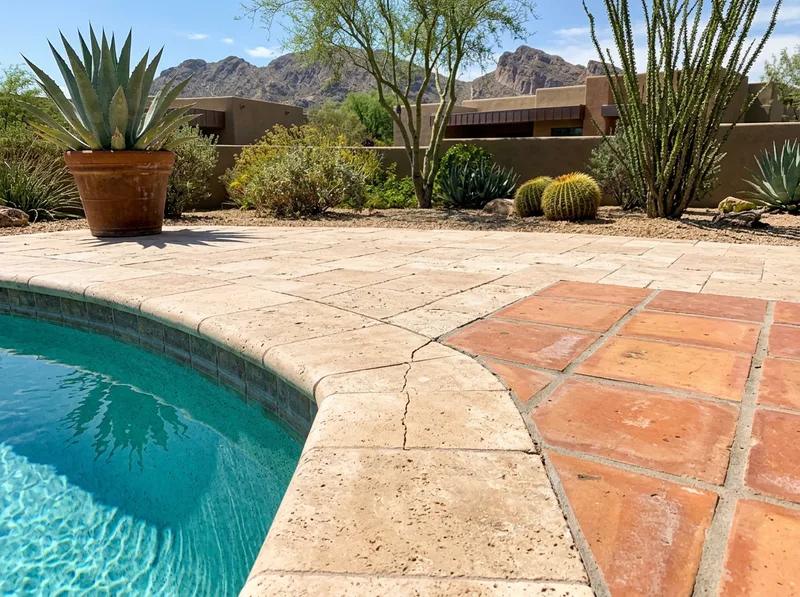
The shell. Cracks in plaster, gunite or fiberglass, and the seals around lights, skimmer throats, main drains and return fittings. Shell leaks usually continue whether the pump is running or not, and they often stop at a particular level — the pool drops to just below a fitting and then holds there, which is a strong clue about where to look.
The buried plumbing. The runs between the pool and the equipment pad. AMWUA suggests watching for wet spots on the ground near the pool, around the equipment, and on the stretch between the equipment and the pool. The City of Phoenix adds soggy ground or sinkholes in the yard, which it lists as evidence of underground line leaks including pool equipment lines. In a Phoenix yard, ground that stays damp is not subtle — nothing else stays damp here.
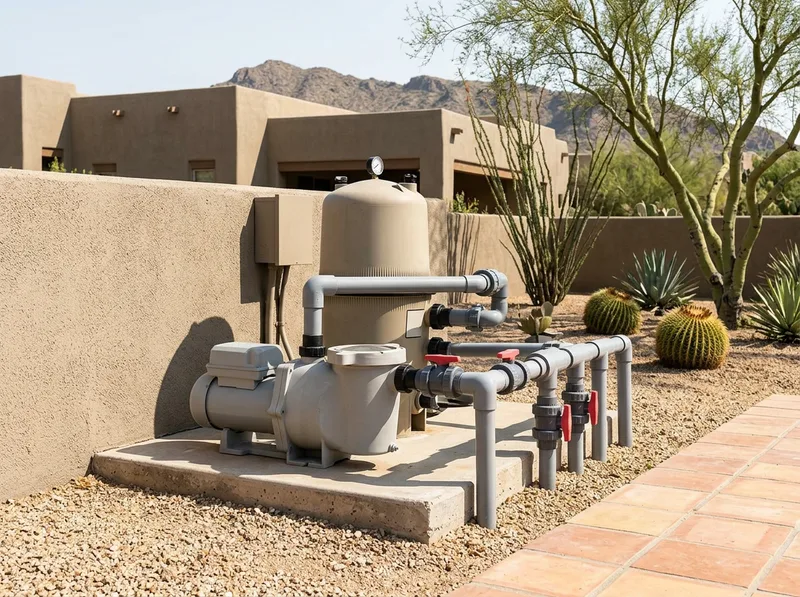
The equipment pad. Pump seals, filter housings, valve unions, heater connections. AMWUA gives the tell for the slow ones: check the pipes for white, crusty mineral deposits. Water escapes, evaporates in the heat, and leaves its minerals behind as a chalky trail — which, given how hard the water is here, builds up fast enough to see. A weeping shaft seal is one of the most common versions of this, and it is covered on our pump and motor page because it is as much a pump problem as a leak.
How is pool leak detection actually done in Phoenix?
Mostly with the pool full. That is worth saying plainly, because being told the pool has to be drained is a reasonable thing to question.
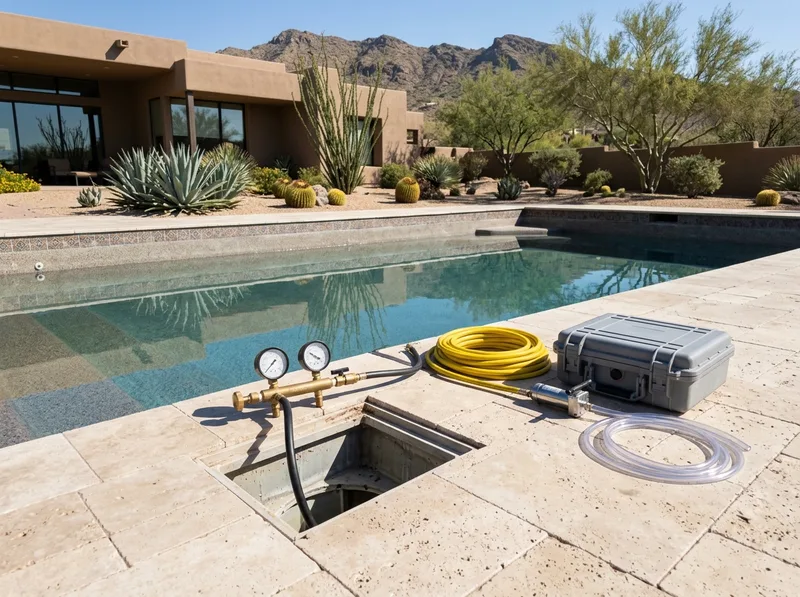
The standard approach is to isolate and pressure-test the plumbing lines one at a time to find which circuit holds pressure and which does not, then use listening equipment along the failing line to narrow down the point. Around fittings, lights and suspected shell cracks, a dye test does the same job visually — dye released next to a crack gets drawn into it. Dye testing needs still water, which is why you may be asked to leave the pump off before the visit.
The City of Phoenix advises consulting a pool professional and notes that “some have leak-detection equipment” — which is a polite way of making a point worth taking seriously. Not every pool company owns the listening gear. When you get quotes, ask what equipment they will bring and what happens if they cannot find it. A company that charges for a search rather than a result should say so up front.
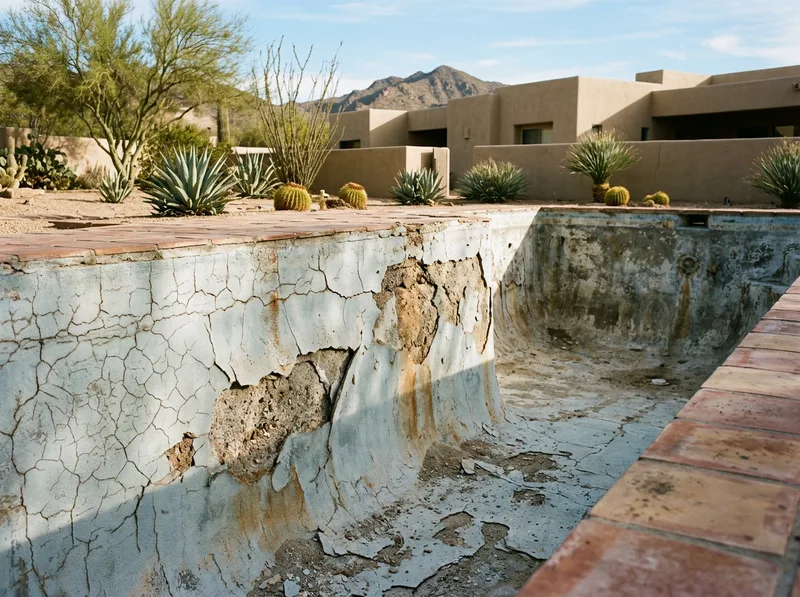
Draining a pool to find a leak is a last resort in Phoenix, not a first step. It wastes the water you were trying to save, and an empty pool in this ground carries its own risks.
What should I send you before booking leak detection in Phoenix?
Four things, and they turn a vague inquiry into a quotable one:
- How much the level drops per day, and over how many days you measured it.
- Your bucket test result — did the pool drop more than the bucket, and by roughly how much?
- Whether the loss changes when the pump is off.
- Whether you have an autofill, and whether it was disabled during the test.
That is enough for a local company to tell you whether they are looking at a shell leak, a plumbing leak or an equipment leak before they arrive. If the level is dropping by inches rather than fractions of an inch, treat it as urgent — there is a short list of what to switch off in the first ten minutes and it starts with the pump.
Leaks rarely arrive alone, either. Water loss puts the pump at risk of running dry, and a heater fed by a starved pump will short-cycle and scale — the interaction is covered on the heater repair page. If you want the wider picture of what fails on a Phoenix pool and roughly what the market charges, start from our main Phoenix pool repair page.
We cover Phoenix plus Gilbert, Tempe, Chandler, Scottsdale and Mesa. If you would rather explain it in your own words first, the number is (602) 833-7014 or you can message us here. Send us a message any time.