Pump or motor? The distinction that changes your Phoenix quote
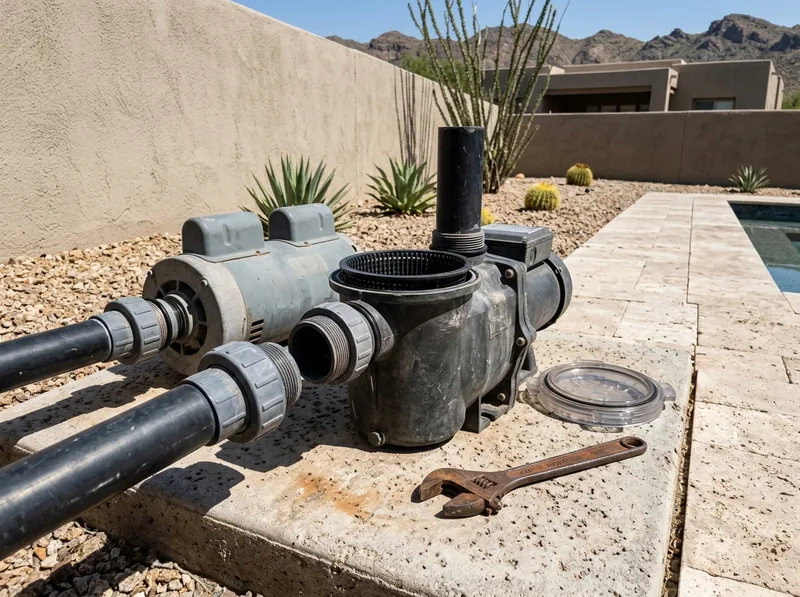
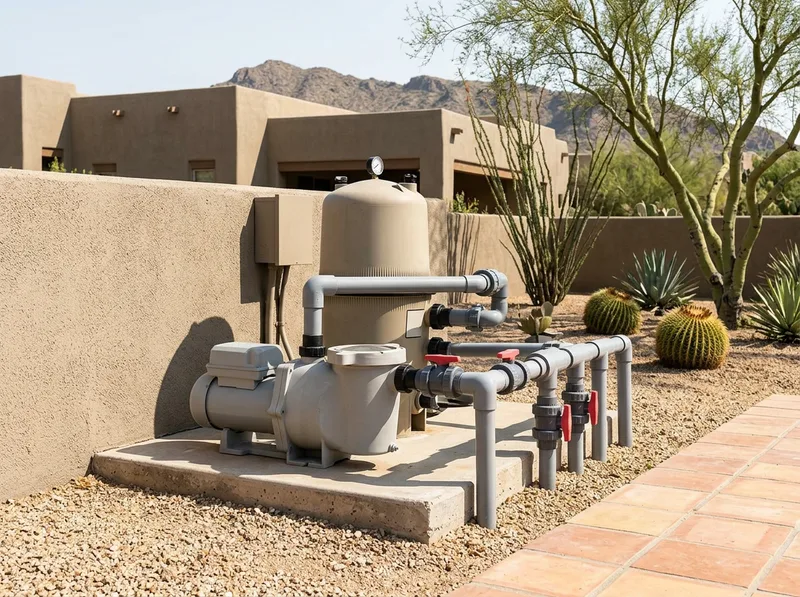
What sits on your equipment pad is two things: a motor, the electrical half that spins, and a wet end, the plumbing half that moves the water — housing, basket, impeller, diffuser and shaft seal. They fail independently, they are replaced independently, and the price gap between them is large.
It is worth naming this because the phrase “pool motor repair” barely appears in the Phoenix market’s own marketing, so homeowners never learn the vocabulary and end up quoted for a full pump when a motor or a seal was the actual fault.
Rough guide to which half is talking to you:
- Loud hum, no rotation. Motor. Usually a failed start capacitor or a seized bearing. The motor is trying and cannot turn.
- Hot or burning smell, breaker tripping. Motor, and stop using it. Repeated resets on a tripping breaker are how a bad motor becomes a fire.
- Screeching or grinding that changes with speed. Motor bearings. This one gets worse, predictably, and is cheapest caught early.
- Runs fine but weak return flow, air in the basket, will not prime. Wet end or suction plumbing. Air is getting in somewhere.
- Dripping from between the two halves. Shaft seal. Left alone, that water gets into the motor and turns a seal job into a motor job.
That last one is worth acting on quickly. A weeping seal is a small repair and a wet motor is not.
What goes wrong with pool pumps in Phoenix specifically?
The failure modes are the same everywhere. The timeline is not.
Hard water is the first reason. A long-established Phoenix pool company puts local pool calcium hardness at 300 to 350 ppm and states that a shaft seal lasting 5 to 7 years in a soft-water state often fails in 3 to 4 years here. Scale is abrasive and it builds on exactly the surfaces a seal relies on to stay watertight.
Heat and sun are the second. The same company cites more than 300 days of UV a year in Phoenix. The casualties are the parts nobody thinks about: the clear pump lid, which goes brittle and cracks, and the lid o-ring underneath it, which hardens and stops sealing while still looking perfectly intact. An o-ring that looks fine is the single most common cause of a Phoenix pump that will not hold prime.
The third is run time. Pool pumps here run long hours through a long season, so they simply accumulate more operating hours per calendar year than the same pump would elsewhere. That is not a defect; it just means calendar age understates wear.
How long should a pool pump last in Phoenix?
A long-established Phoenix pool company publishes 8 to 12 years for pool pumps locally, and separates that further: single-speed pumps at 5 to 8 years and variable-speed pumps at 8 to 12, on the grounds that a variable-speed pump spends most of its life turning slowly and putting less load on its bearings and seals. Those are their published figures, not ours.
Use that as the frame for a repair-or-replace decision. A $500 part on a three-year-old pump is straightforward. The same part on a nine-year-old single-speed pump is buying a year or two at the price of a large chunk of a new one, and the running-cost argument below usually settles it.
Is a variable-speed pump worth it in Phoenix?
Start with how much the pump costs you at all. SRP describes the pool pump as “likely the second-largest electricity user in your household”, and ENERGY STAR independently puts it the same way — your pool pump “could be your home’s second largest energy user, costing you as much as $310 in energy every year”. Two organizations with nothing to sell you, agreeing.
We are deliberately not quoting you a headline savings percentage, and it is worth explaining why. The figures in circulation do not agree with each other — ENERGY STAR’s own pool pump page carries both “20% less energy” and “70 percent less energy” in different places, and pool companies advertise numbers higher again. When the sources disagree that much, the honest thing is to give you the mechanism instead of picking whichever number sounds best.
Here is the mechanism, in ENERGY STAR’s own words: “reducing pump speed by one-half allows the pump to use just one-eighth as much energy.” That is the whole argument for variable speed. Halve the speed and the power draw falls to an eighth; run it twice as long to move the same water and you have still used a quarter of the electricity.
Which leads to the part most people miss: the saving comes from how the pump is operated, not from owning one. A variable-speed pump run at full speed on the old schedule saves you very little. Run slowly, for longer, it saves a lot. If you buy one, make sure whoever installs it sets the speeds and the schedule — and ask them what they set it to.
ENERGY STAR adds a second lever that costs nothing at all and applies to any pump: “Running your pool filter only 6 hours a day versus 24 hours, will reduce your energy use by 75%.”
Is there a rebate for a variable-speed pool pump in Phoenix?
No, and this is worth stating clearly because a lot of pool advice written for other states assumes there is one.
SRP’s current residential rebate list runs to air conditioning, cool roofs, duct testing and repair, heat pump water heaters, insulation, LED lighting, shade screens and window film, smart thermostats, window replacement and EV chargers. No pool pump.
We could not find a residential pool pump rebate published by APS either. APS runs a marketplace rather than a rebate list, and our search was of their public pages rather than a conversation with them, so check directly before you rule it out. But do not build the purchase around a rebate until someone at the utility has confirmed one to you.
The savings that are real here are operational, and they are in the next section.
How long should I run a pool pump in Phoenix, and when?
Both local utilities publish guidance, and following it costs nothing at all.
SRP’s recommendation is eight to 12 hours a day in summer and six to eight in winter, on a timer, running “only as long as necessary each day to keep the water clean” — and during off-peak hours if you are on a time-of-day plan.
APS is more specific about the winter window and puts a number on it: run the pump during super off-peak hours from 10am to 3pm, and “you could save up to $120 a year” on a time-of-use plan.
Two other things SRP recommends that reduce load on the pump directly: clean the strainer baskets and filters regularly, and keep the pool chemistry balanced rather than compensating with longer filter runs. A pump pulling against a clogged basket works harder for less flow, which is wear you are paying for twice.
What should I tell a Phoenix pool company about the pump?
Five details, and they are all things you can establish without tools:
- What the pump does when you switch it on — hums, spins, nothing, trips the breaker.
- What noise it makes, and whether the noise changes with speed.
- Whether the basket fills with water and stays full, or holds air.
- Whether there is water dripping between the motor and the wet end.
- Roughly how old it is, and whether it is single-speed or variable-speed.
That is enough for a company to arrive with the likely part rather than arrive to look. If the pump has been running dry or pulling air, say so and say for how long — that changes the diagnosis significantly.
A pump that is losing prime may not be a pump fault at all. If your water level is dropping, the pump is a symptom, and the free test on our leak detection page should come first. A starved pump also starves the heater downstream of it, which is a common cause of the short-cycling described on the heater repair page. And if the pump is screaming, smells hot, or is tripping a breaker right now, switch it off — that is on the short list of things that cannot wait.
For the wider picture of what fails on a Phoenix pool and what the local market charges, start from the main pool repair page. We cover Phoenix, Mesa, Scottsdale, Gilbert, Tempe and Chandler — the full list is on the service areas page. You can also call (602) 833-7014 or send a message. Send us a message any time.