We are a Phoenix pool repair referral service. Tell us what's wrong and we'll connect you with a local pool repair company.

The city states that hardness in its drinking water ranges from a low of 5 grains per gallon to a high of 20, and that the average across the city is 16.5.

A five-grain pool and a twenty-grain pool are not the same machine to look after, and both are in Chandler. Tell us what yours is doing and we will connect you with a local pool repair company.

Prefer to talk? The number is (602) 833-7014. The form is quicker, and it is the only one of the two that reaches someone straight away.

Get Chandler pool repair quotes

Tell us what is wrong and we will connect you with a local pool repair company covering Chandler. No cost, no obligation.

No cost and no obligation. We are a referral service, not a pool contractor: by sending this you are asking us to pass your details to a local Phoenix pool repair company, who may call, text or email you about your pool. You can tell either of us to stop at any time — what we do with your details is in our privacy policy. Send us a message any time.

Why does Chandler have three different water supplies?

Because it built three. The city sets it out directly: the Chandler Surface Water Treatment Plant provides the majority of the city's water, taking it from the Salt and Verde rivers by way of the consolidated canal, and supplied 60 percent of the total drinking water. The Santan Vista Water Treatment Plant — shared with the Town of Gilbert — provides roughly 20 percent. A network of 32 groundwater wells across the city supplies the balance.

Three supplies, three mineral profiles. Santan Vista runs on Central Arizona Project water, which is Colorado River water; the Chandler plant runs on Salt and Verde river water; the wells are groundwater. That is why the city's own figure is a range and not a number, and it is the honest reason a neighbour's pool advice may simply not apply to yours.

The 5-to-20 spread is the widest on this site, and it is four times as much mineral at one end as the other. On a pool, four times the mineral is not four times the inconvenience — it is roughly four times the rate at which a salt cell scales, a heat exchanger coats and a tile line crusts. Everything else being equal, a Chandler pool on the well side and a Chandler pool on the CAP side will need different things at different intervals.

If your pool scales faster than everyone tells you it should, this is very often why, and no amount of chemistry adjustment fixes a misdiagnosis. Working out what is actually happening to the equipment is the first useful step, and that is what a repair assessment is for.
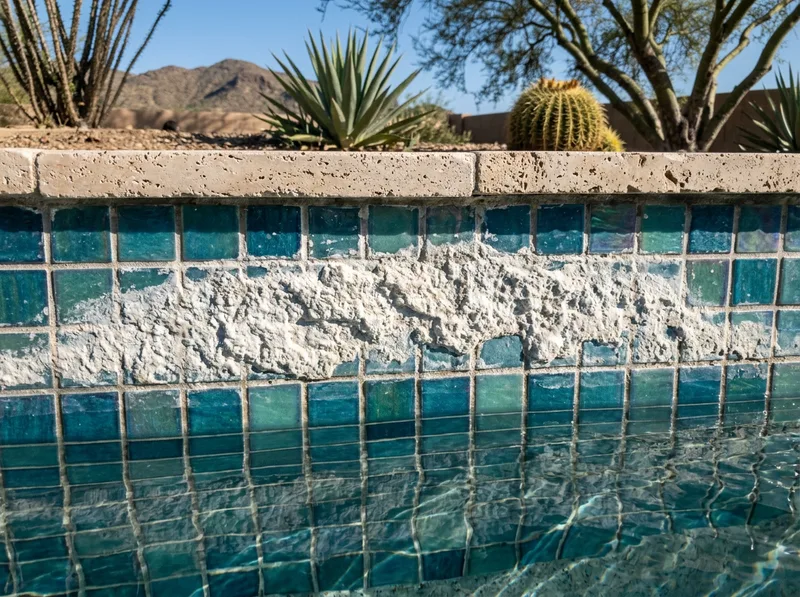
Thick chalky white calcium crust banded across teal glass mosaic waterline tiles, with clean tile visible above and below the band.
A pool on the 20-grain end of the city supply crusts up roughly four times faster than one on the 5-grain end. Both are in Chandler.

How old is the typical Chandler pool?

Newer than most of the Valley, older than Gilbert. The American Community Survey puts the median Chandler home at 1997, with a median home value of $507,800. That sits Chandler squarely between the 1980s stock in Phoenix, Tempe and Mesa and Gilbert's 2003 median.

A late-nineties pool is at an awkward age. It is old enough that the original plaster is well past its useful life and the first generation of equipment is long gone, but new enough that the plumbing and structure are usually sound. So the work tends to be surfaces and equipment rather than excavation — which is the better end of the range to be in, but is still the point at which a pool starts costing real money.

That age also puts most Chandler pools squarely inside the era when equipment pads were built for single-speed pumps and simple mechanical timers. Retrofitting a modern variable-speed pump onto one is usually worthwhile, but it is a retrofit rather than a swap — the plumbing, the electrical supply and the control scheme were all sized for something else, and quotes that ignore that tend to be the cheap ones.

It is also the age where the second round of decisions arrives. The first replacement pump is now itself ten or fifteen years old, the first replacement heater is due, and whatever automation was retrofitted in the 2000s is either obsolete or unsupported. Those are cheaper decisions than a 1985 pool's, but there are more of them close together.

The single most useful thing at that age is knowing which items are genuinely finished. A pump nearing the end of its life takes the rest of the system down with it in efficiency terms long before it stops. Pool pump repair in Chandler is the place to establish that, because the pump's condition decides how hard everything else has to work.

What does 20-grain water do to a heater?

It coats the heat exchanger in calcium, and then the heater slowly stops making sense. Gas keeps burning at the same rate but less of that heat gets into the water, so run times climb, gas bills climb, and eventually a safety cut-out trips because components are running hotter than designed.

Nothing about that presents as a heater fault until the day it stops. Owners on the harder end of Chandler's supply see it sooner than owners on the softer end, which is precisely why the citywide average of 16.5 grains is the wrong number to plan around — plan around yours.

Salt cells behave the same way: scaled plates, falling output, and a controller reporting a salt problem that adding salt will not solve. It is the single most commonly misread fault on a Valley pool, and it is worth ruling out before buying a replacement cell.

Whether a heater can be descaled or has already been cooked is a question about run hours and internal condition, not about the model number. Pool heater repair in Phoenix covers the diagnosis as well as the fix, and the diagnosis is the part that decides the cost.

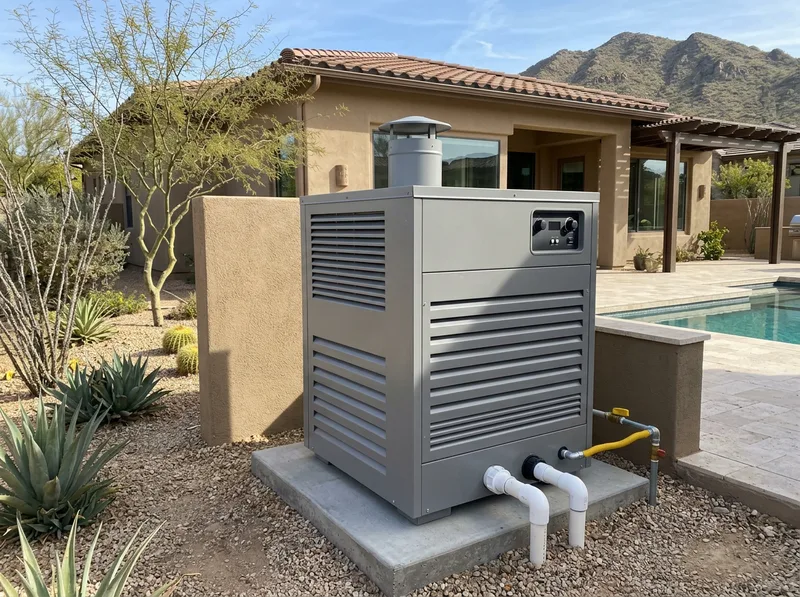
A gray gas pool heater standing on a concrete pad beside a pool, connected to a yellow gas line and white PVC plumbing.
The scale is on the heat exchanger inside. From the outside a heater that is costing twice the gas looks exactly like one that is not.

Is the pool leaking?

In a Valley summer that question is genuinely hard, because evaporation here is fast enough to disguise a real leak, and a slow leak is easy to write off for an entire season. The cost of getting it wrong is not just water — it is a wet subgrade, a moving deck and eventually a structural problem that costs many times what the leak repair would have.

A bucket test is a reasonable first move and costs nothing. Float a filled bucket on a step so the water inside starts level with the pool, mark both, switch the autofill off, and compare after twenty-four hours. If the pool has dropped further than the bucket, the difference is your leak rate.

Beyond that it is pressure testing and listening equipment rather than guesswork, and it is worth doing properly because the visible symptom rarely sits above the actual fault. Finding out where the water is going is a defined job with a definite answer.

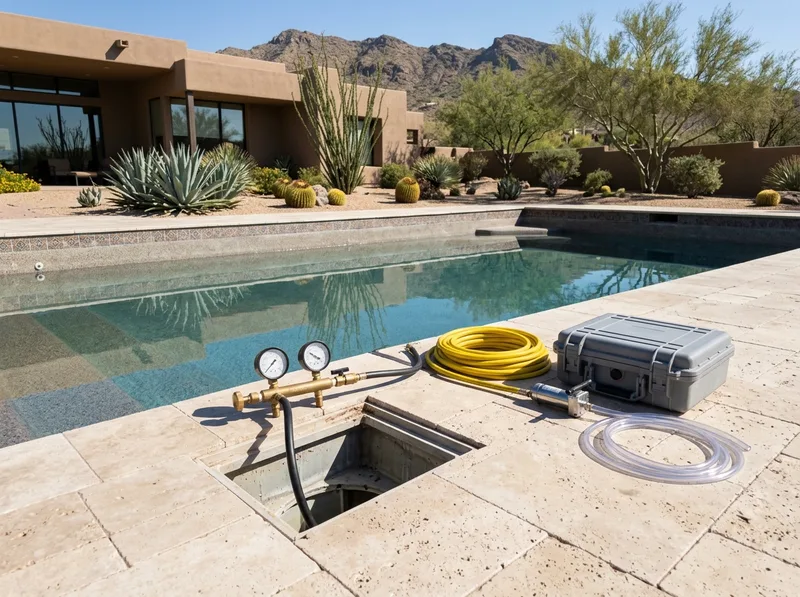
A pressure-test gauge manifold connected into an open valve box at the edge of a pool, with a coiled hose and an equipment case beside it.
Pressure on the lines and gauges to read it. A bucket test tells you whether to bother; this is what tells you where.

What does the fence law require in Chandler?

A.R.S. §36-1681 is the state floor: a five-foot barrier around any contained water 18 inches or more deep and wider than 8 feet, no opening a four-inch sphere can pass through, gates self-closing and self-latching, opening outward, latch at least 54 inches above the ground, and the barrier at least 20 inches back from the water's edge.

The statute defers to a local ordinance that is equal to or more stringent, and Chandler is its own city. Confirm the local requirement before you drain the pool or remove a panel to get equipment in — that is the moment a barrier stops working, and it is the moment it gets checked.

If a gate, a fence or a drained pool has already become a problem, mark the inquiry urgent and it goes out on the emergency route rather than into the normal schedule.

How do I find out which Chandler supply my street is on?

Ask the city, and in the meantime read your own pool. The three supplies are the Chandler Surface Water Treatment Plant, the Santan Vista plant shared with Gilbert, and the well network, and which one reaches a given street is a question the utility can answer far better than a website can.

The pool itself gives you a decent proxy, though. Two indicators are worth watching over a season. The first is how quickly a visible line of scale returns to the waterline tile after it has been cleaned off — weeks rather than months puts you toward the hard end. The second is how often a salt cell needs inspecting before its output falls; a cell that scales visibly within a season is telling you something about the fill water, not about the cell.

A calcium hardness test on the pool water itself is not the same measurement as the city's tap figure, because a pool concentrates minerals as it evaporates and gets topped up. But tested against fresh tap water from the hose, side by side, it does tell you where you are starting from — and that is the number that matters when you are deciding how aggressive a maintenance schedule needs to be.

None of this is worth doing for its own sake. It is worth doing because it changes the answer to one practical question: whether the equipment on your pad is failing early because of a fault, or on schedule because of the water. Those get fixed very differently.

It is also the question that decides whether a softener or an inline treatment is worth considering for the top-up line. That is a genuine decision with real trade-offs on a twenty-grain supply and a waste of money on a five-grain one — and Chandler contains both. Anybody selling you the answer without knowing which of the three supplies feeds your street is guessing, and the guess is free for them and not for you.

Pools in Tempe or Gilbert?

Both are on this site with their own numbers. Tempe has the widest seasonal swing in the Valley, from 10.4 to 32.6 grains, and the oldest housing of the six. Gilbert, next door shares the Santan Vista plant with Chandler and still averages 10 grains, because the rest of its supply is different.

The full list has all six, each with the figures that city publishes for itself.

Tell us about your Chandler pool

We pass your details to a local pool repair company so they can quote you directly. Send us a message any time.

No cost and no obligation. We are a referral service, not a pool contractor: by sending this you are asking us to pass your details to a local Phoenix pool repair company, who may call, text or email you about your pool. You can tell either of us to stop at any time — what we do with your details is in our privacy policy. Send us a message any time.

Get a Free QuoteCall