We are a Phoenix pool repair referral service. Tell us what's wrong and we'll connect you with a local pool repair company.

It is a separate incorporated city that runs its own water utility, sets its own rules and reports its own water quality.

The City of Mesa states that water hardness here ranges from 12 grains per gallon to 22, depending on the water source that serves your area. That is a wide band for one city, and it is the single most useful thing to know before you spend money on pool equipment. Tell us what is wrong and we will connect you with a local pool repair company.

Prefer to talk? The number is (602) 833-7014. The form is quicker, and it is the only one of the two that reaches someone straight away.

Get Mesa pool repair quotes

Tell us what is wrong and we will connect you with a local pool repair company covering Mesa. No cost, no obligation.

No cost and no obligation. We are a referral service, not a pool contractor: by sending this you are asking us to pass your details to a local Phoenix pool repair company, who may call, text or email you about your pool. You can tell either of us to stop at any time — what we do with your details is in our privacy policy. Send us a message any time.

Why does Mesa water hardness vary by 10 grains?

Because Mesa does not have one supply. The city is explicit that the number depends on the water source serving your area, which means where you live decides how fast calcium builds up on your tile, in your heater and on your salt cell.

At the soft end, 12 grains is still hard water by national standards. At 22, you are close to Scottsdale's worst zone. The difference between those two ends is roughly the difference between draining and acid-washing a salt cell once a year and doing it three times, and over a decade that is a meaningful amount of money for something that looks like the same pool from the deck.

Mesa publishes something else that is genuinely useful and almost nobody quotes: softening water raises sodium by about 8 milligrams per liter for every grain of hardness removed. At 12 grains, that is 96 mg/L added. That figure is about drinking water rather than pool water, but it is a fair illustration of how much mineral is actually dissolved in there — and all of it stays behind when pool water evaporates.

Which end of the band you are on is not something you can see, and it is not something a maintenance company will necessarily volunteer. It is worth asking, because it changes what a reasonable service interval looks like for your pool specifically. It also changes how to read a piece of equipment that has failed sooner than its warranty suggested it should — on the hard end of Mesa's range, that is often the water rather than the manufacturer, and knowing which matters if you are deciding whether to buy the same model again.

How old is the typical Mesa pool?

The American Community Survey puts the median Mesa home at 1989. That sits Mesa third-oldest of these six cities, behind Tempe and Phoenix and ahead of Scottsdale, Chandler and Gilbert.

A 1989 pool is now in the window where several things reach end of life at once. Plaster surfaces do not last indefinitely in this climate, pumps have a finite life here, and the first generation of automatic cleaners, timers and heaters fitted to that era of pool are long gone. It reads as the pool suddenly costing money after years of costing nothing, and that is usually several separate components arriving at the end of their lives in the same couple of seasons.

There is a second-order effect worth naming. A pool of this age has usually had at least one major component replaced already, and that replacement resets nothing else — a five-year-old pump on a thirty-five-year-old pad is still sitting on thirty-five-year-old plumbing, unions and electrical. Owners reasonably take a recent replacement as evidence the system is in decent shape. It is evidence about one item.

The sequencing matters more than the total. Replacing the pump in March and discovering in June that the filter also needed doing is two mobilizations, two call-out charges and two days without a pool. Finding out in one visit which items are finished and which have years left is how that turns into one job.

It is worth having someone identify what is actually urgent instead of replacing things in the order they fail. That is the point of a proper repair diagnosis rather than a parts quote.
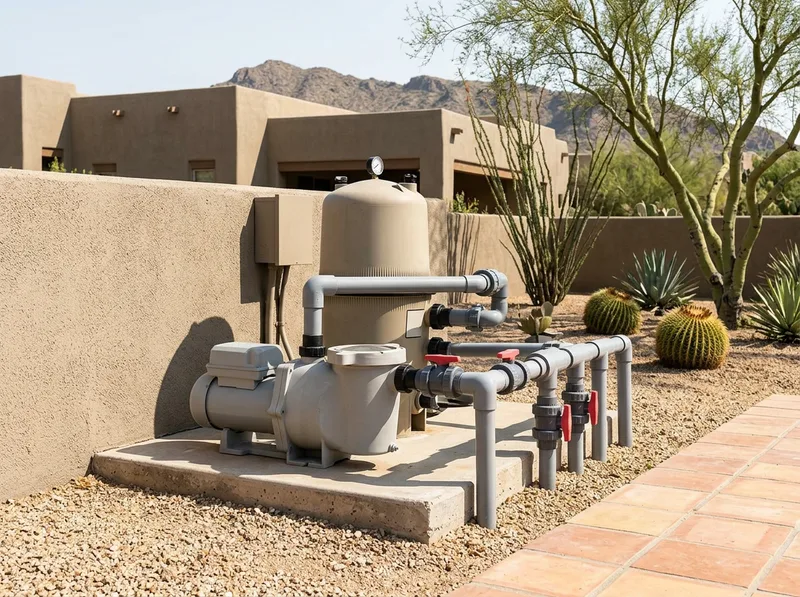
A pool equipment pad holding a filter tank with a pressure gauge, a pump, and a row of PVC valves on a concrete slab.
On a median 1989 build, several items on the pad reach the end of their lives within a season or two of each other.

What breaks first on a Mesa pool?

Usually the pump, and usually not dramatically. A pool pump that is failing rarely stops — it gets louder, it runs hotter, it starts tripping a breaker on the hottest afternoons, and the water clarity quietly gets worse because flow has dropped. On hard water, an impeller and a seal plate can pack with calcium and put the motor under load it was never designed to carry.

The reason this matters in Mesa specifically is the age profile. On a 1989-era build the pump is very likely a single-speed motor on original plumbing, and replacing like for like is not always the right call — nor is fitting the biggest available replacement, which on undersized old pipework will cavitate and fail early. That is why pump and motor repair is rarely a straight swap on a pool of this vintage.

Second most common is water loss, and it is the one people leave longest. A pool losing an inch a day in June looks like evaporation and often is not. The bucket test settles it in twenty-four hours and costs nothing: float a filled bucket on a step, mark the water level inside and outside, turn off the autofill, and compare the next day.

If the pool has lost more than the bucket, working out where the water is going is a measurable job with a definite answer, which beats another summer of topping up and wondering.

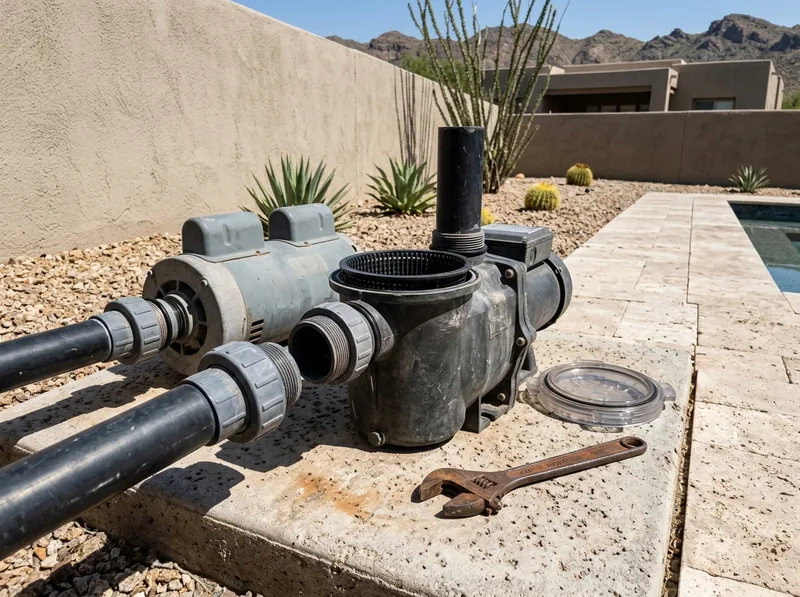
A pool pump opened up on a deck with its strainer basket exposed, the clear lid set to one side and a wrench alongside.
The strainer basket and impeller housing. Calcium packing either one drops flow long before the motor actually stops.

Does Mesa follow the state pool fence law?

Arizona's statute, A.R.S. §36-1681, sets the statewide minimum: a five-foot barrier for any contained body of water 18 inches or more deep and wider than 8 feet, no opening a four-inch sphere can pass, gates self-closing and self-latching, opening outward, latch at least 54 inches up, and the barrier at least 20 inches back from the water's edge.

The statute also says explicitly that it does not apply where a political subdivision has adopted its own ordinance that is equal to or more stringent. Mesa is its own political subdivision. So the state law is the floor, not necessarily the rule that applies to your address — confirm with the city before you take a fence down to get equipment in, or before you drain.

That second one catches people. A drained pool is not a pool in the everyday sense, but it is still a hole with a hard bottom, and the moment a barrier comes down to get a crew and equipment through is exactly the moment it stops doing its job.

If the pool is already drained, or a gate is already off, that is not a next-week problem. Say so on the form and it goes out as same-day work.

What about the heater?

Hard water is unkind to heaters, and Mesa's upper band is hard. Scale on a heat exchanger does not usually cause a clean failure — it causes a heater that takes longer and longer to reach temperature, burns more gas doing it, and then fails a safety cut-out on a hot day. The two mistakes it invites are opposite ones: replacing a heater that could have been descaled, or descaling one that has already been cooked.

The tell is run time rather than temperature. A heater that used to bring the pool up overnight and now needs a day and a half has not lost its thermostat; it has lost heat transfer. By the time it trips out, that has usually been true for a season or two.

Which of those you are looking at depends on age, run hours and how bad the scale actually is, and it is worth booking heater repair rather than replacement until someone has opened it up, instead of quoting a new unit off the model number.

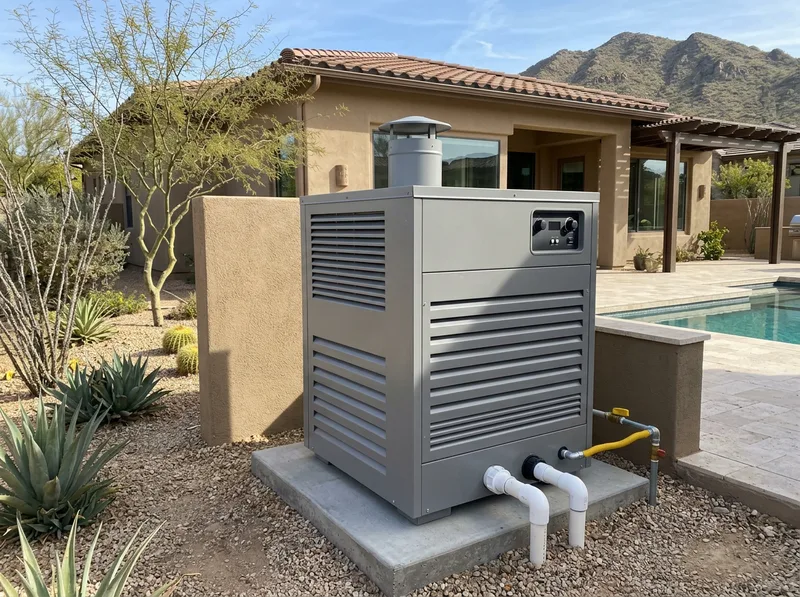
A gray gas pool heater standing on a concrete pad beside a pool, connected to a yellow gas line and white PVC plumbing.
Nothing about a scaled heat exchanger shows from outside. On the 22-grain end of the city supply it arrives years sooner than on the 12-grain end.

What happens after you send the form?

We pass what you wrote to a local pool repair company that works your part of Mesa. They contact you and quote you directly. There is no charge to you and no obligation to accept anything.

The more specific the description, the better that works. "The pump is loud and trips the breaker after about an hour" gets a useful answer. "Pool problem" gets a call to find out what you meant. Model numbers off the equipment pad help too, if you can get to them safely — they tell a company what parts to bring.

We are not the contractor and we do not do the work, so we have no reason to talk you into anything. That is worth saying plainly, because plenty of sites in this business do not — a site that reads as though it owns trucks and crews, and then hands your details to whoever bought the lead, has told you something untrue before the conversation even starts.

It also means we cannot quote you, promise a time, or tell you what a part costs. Anyone who could do that has to look at the pool first. What we can do is make sure the description that reaches them is the one you actually wrote, rather than a category ticked on a form.

Pools in Gilbert or Phoenix instead?

Different city, different water. Gilbert has the softest supply of the six — its own report gives an average of 10 grains — and much newer housing. The Phoenix page is the opposite end: the oldest median build date here, and hardness that changes with which of five treatment plants serves you.

The six cities are listed here, each with the numbers that city publishes rather than a Valley-wide average that fits nobody in particular.

Tell us about your Mesa pool

We pass your details to a local pool repair company so they can quote you directly. Send us a message any time.

No cost and no obligation. We are a referral service, not a pool contractor: by sending this you are asking us to pass your details to a local Phoenix pool repair company, who may call, text or email you about your pool. You can tell either of us to stop at any time — what we do with your details is in our privacy policy. Send us a message any time.

Get a Free QuoteCall