Phoenix is the hardest of these six cities to generalize about, and pool repair is where that shows up.
We are a Phoenix pool repair referral service. Tell us what's wrong and we'll connect you with a local pool repair company.
The city runs five water treatment plants drawing on three different rivers, and its own 2025 water quality report puts total hardness anywhere between 172 and 302 parts per million. That is a spread of 10 to 17.6 grains per gallon depending on which plant fills your pool. Two pools eight miles apart can scale at noticeably different rates, and neither owner has done anything wrong.
Tell us what the pool is doing and we will pass it to a local Phoenix pool repair company. It costs nothing and you are not committing to anything.
Prefer to talk? The number is (602) 833-7014. The form is quicker, and it is the only one of the two that reaches someone straight away.
Older than most people expect. The Census Bureau's American Community Survey puts the median year a Phoenix home was built at 1985 — the oldest of the six cities on this site, tied with Tempe. If the pool went in with the house, it is around forty years old.
Forty years is three or four surfaces and three or four pumps. It is also long enough for the original plumbing, the skimmer throat, the bond beam and the deck joint to have moved. That matters when you are working out whether a problem is one failed part or something bigger.
The practical version: on a pool this age, a single symptom is worth diagnosing properly rather than parts-swapping. A pump that trips its breaker can be a capacitor, or it can be a motor that has been drawing hard for two years because the impeller is packed with calcium. Those cost very different amounts to put right, and only one of them stays fixed. Start with what a proper diagnosis actually covers.
It also changes what "normal" looks like. On a pool built in the last decade a component failing is an event; on a 1985 pool it is a schedule. The useful question is which thing is closest, and someone who has opened the equipment pad can usually tell you in one visit — far cheaper than discovering it in July.
Because it comes from three rivers, not one. The city's 2025 report names the Salt, Verde and Colorado as its primary sources of untreated surface water, with some Agua Fria River water mixed with Colorado River water in Lake Pleasant. In 2025 about 97 to 99 percent of the supply was surface water that mostly started as mountain snowpack, delivered to five treatment plants serving roughly 1.7 million people.
Different river, different mineral load, different plant. That is why the hardness figure in the report is a range rather than a number. Scale on the tile line, cloudiness that will not clear, and a salt cell that needs acid-washing more often than the manual suggests are all downstream of it.
None of this is visible in the water — it looks the same at 10 grains as at 17. What differs is the rate at which calcium settles on the waterline tile, inside a heater, on the plates of a salt cell. Two identical pools on identical schedules will not be in identical condition after five years if they are on different plants.
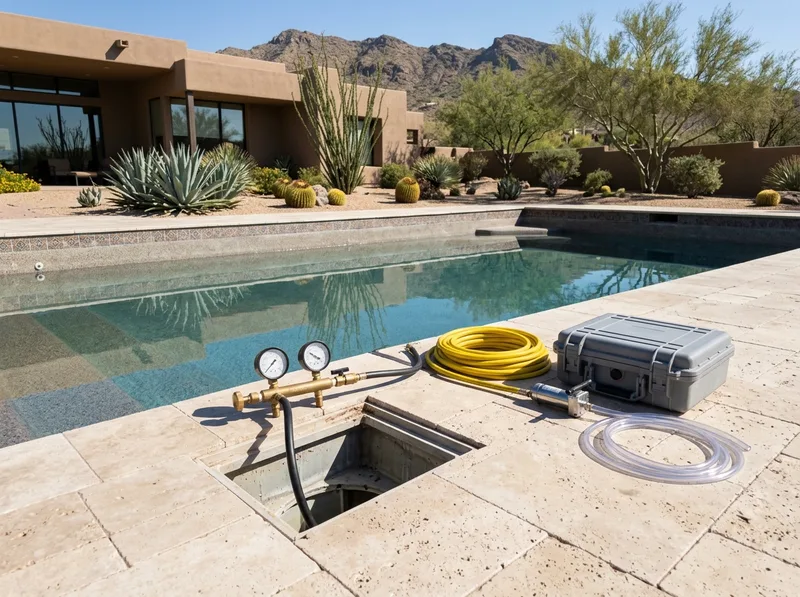
If your pool is losing water and you have assumed it is evaporation, it is worth ruling out properly — Phoenix summers hide a slow leak very well. Pool leak detection in Phoenix is a specific piece of work with its own equipment, not something you eyeball.

All of them. Phoenix divides itself into 15 urban villages — Ahwatukee Foothills, Alhambra, Camelback East, Central City, Deer Valley, Desert View, Encanto, Estrella, Laveen, Maryvale, North Gateway, North Mountain, Paradise Valley, Rio Vista and South Mountain — and they are not interchangeable. A 1950s Encanto pool and a 2015 Desert View pool are different jobs with different failure modes.
That is not a technicality. The villages were laid out at very different times, so the pool behind the house tends to match the era of the house in front of it. Older central villages skew toward small, deep plaster pools on original plumbing; the newer edges toward larger, shallower builds whose pads were designed for variable-speed pumps. The same fault on the two is not the same repair.
Tell us the village or just the cross-streets on the form. It goes to a company that works that side of the city, which is more useful than a company that technically covers the whole Valley and will quote you a drive time.
Three things, none of which need tools, and all of which make the quote you get more useful.
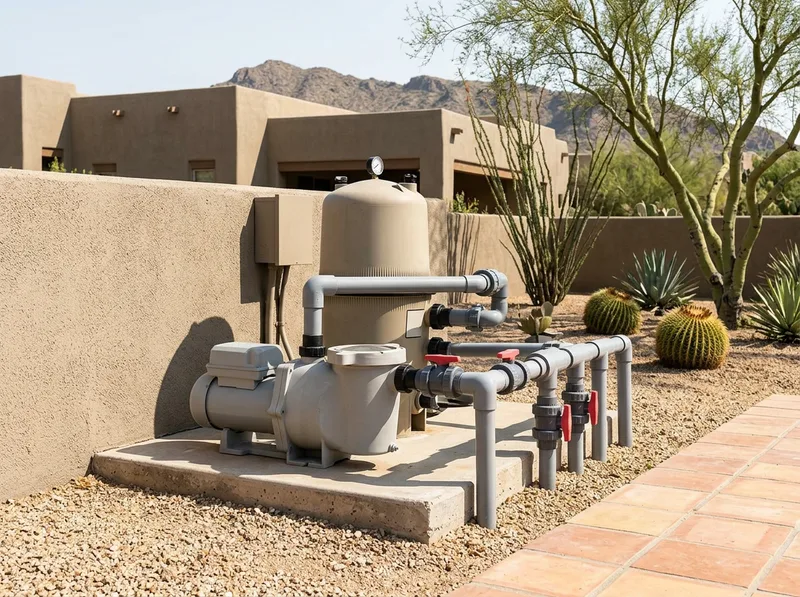
First, the pump basket and the skimmer basket. If either is packed, flow drops, and a pool that is cloudy or slow to clear may have nothing wrong with it at all. Empty both, run the pump, and see whether anything changes over a day.
Second, the filter pressure gauge. Write down what it reads with a clean filter, then watch it. A pressure that climbs steadily is a filter that needs cleaning. A pressure that has dropped below normal usually means something upstream is restricting flow, and that is a different problem entirely.
Third, if the water level is falling, do a bucket test before you do anything else. Fill a bucket, stand it on a step so the water inside and the pool water start level, mark both, turn the autofill off, and come back in a day. If the pool has dropped further than the bucket, that is a leak, not evaporation. If they match, it is evaporation and you can stop worrying about it.
Those three answers turn "the pool is not right" into something specific, which is what gets you an accurate quote.
More than most owners plan for. The National Weather Service defines the monsoon season as June 15 through September 30 and states that monsoon thunderstorms can cause damaging winds, torrential rainfall, frequent lightning and dust storms.
For a pool, the dust is the part that matters most and the part nobody expects. A dust storm loads the water with fine sediment that goes straight through a skimmer and into the filter, which then works far above its normal duty for days. Filter pressure climbs, flow falls, and the pump — often already the oldest thing on the pad — runs hot against the restriction. That is why so many pump failures in the Valley happen in the weeks after a storm rather than during one.
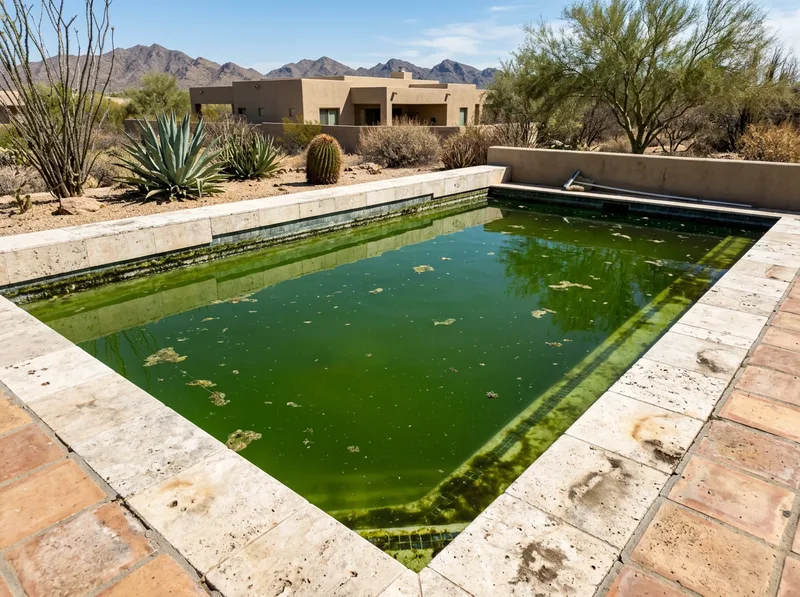
Wind adds the rest: debris in the basket, a torn cover, occasionally damage to equipment. And a pool that has been chemically overwhelmed goes green fast in 100-degree water.
If storm damage has taken the pool out and it cannot wait for a scheduled visit, say so on the form and it is treated as urgent pool repair rather than as a booking.

We are a referral service, so we have no prices of our own and will not pretend otherwise. What we can do is point at what an established local company publishes.
A long-established Phoenix pool company — one that has operated in the metro since 1957 — publishes on its own site that most pool resurfacing jobs here run $6,500 to $15,000, that a full remodel typically costs $15,000 to $65,000 or more, and that pool pumps in Phoenix typically last 8 to 12 years, shorter than the national average, which it attributes to hard water and summer heat.
Treat those as market context, not as a quote. Your number depends on your pool, its size, its condition and what is actually wrong with it. That is the whole reason the form asks what the pool is doing rather than offering a price list — a real quote comes from someone who has looked at it.
It is also worth knowing which way the range runs before you take advice. A pump replacement and a resurface are two orders of magnitude apart, and the wrong diagnosis is what moves you from one to the other. If the pump is the problem, start with a pump that hums but will not turn; if the heater has stopped making sense, what heater repair involves when scale is the cause is a different conversation entirely.
Arizona sets a statewide floor in A.R.S. §36-1681. It applies to any contained body of water 18 inches or more deep and wider than 8 feet, and it requires a barrier of at least five feet measured from the outside, with no opening a four-inch sphere can pass through. Gates must be self-closing and self-latching, must open outward from the pool, and the latch must sit at least 54 inches above the ground.
Two parts of that statute matter for older Phoenix pools specifically. It does not apply to a pool or barrier built before the article took effect, and it does not override a city ordinance that is equal to or more stringent. So a 1970s pool may be grandfathered under state law and still be subject to a city rule. Check with the City of Phoenix before you drain, refence or re-deck — not after.
Draining is when this usually comes up — a drained pool with the gate propped open for equipment access is exactly the situation the law exists for. Settle it before the work is booked, not on the morning a panel has to come out.
Then read the page for the city it is in, because the water is genuinely different. Scottsdale is on noticeably harder water than most of Phoenix — up to 25 grains in its southern zone. Tempe pool repair has its own quirk: the blend of Salt and Verde river water shifts with the seasons, so the hardness there swings more than anywhere else on this site.
The full list of cities covers Phoenix, Scottsdale, Mesa, Gilbert, Tempe and Chandler. Six pages, each with the numbers for that city, rather than thirty pages of the same paragraph with the name changed.