Tempe has the most volatile pool water on this site, and the city documents it itself.
We are a Phoenix pool repair referral service. Tell us what's wrong and we'll connect you with a local pool repair company.
Its 2025 water quality report gives an average hardness of 12.3 grains per gallon and a range of 10.4 to 32.6 — a spread of more than three to one within a single city, in a single year.
That is not a measurement error. Tempe explains the cause plainly, and it changes how a pool here should be looked after. Tell us what yours is doing and we will connect you with a local pool repair company.
Prefer to talk? The number is (602) 833-7014. The form is quicker, and it is the only one of the two that reaches someone straight away.
Because the rivers behind it are not the same water. The City of Tempe's own explanation is that the Salt River is characteristically higher in total dissolved solids and chlorides, while the Verde River is higher in hardness compounds — and the blend supplied to Tempe's treatment plants changes seasonally and year to year, depending on precipitation and snowmelt runoff in the mountains.
On top of that, Central Arizona Project water reaches Tempe through the CAP-SRP Interconnection Facility. In 2025 the CAP supplied one billion gallons of Colorado River water to the city. So the fill water going into a Tempe pool in March is genuinely not the same water that goes in during September.
The practical consequence is that Tempe pool owners get caught out by a routine they set once. A dosing habit that held the water balanced last spring can be wrong this spring, and the pool starts scaling or etching for no reason the owner changed. It reads as a chemical problem that has appeared from nowhere, and the instinct is to dose harder, which makes it worse in whichever direction it has already gone.
If the chemistry no longer behaves and nothing about your routine has changed, that is worth investigating rather than treating. A repair assessment covers the equipment side of it, which is where the problem often turns out to be hiding.
The oldest here. The American Community Survey puts the median Tempe home at 1984 — a year older than Phoenix, five years older than Mesa and nineteen older than Gilbert.
That age changes the whole conversation. A pool from the early eighties has been resurfaced several times, has original main-drain and return plumbing under a deck that has moved, and has almost certainly had equipment replaced piecemeal by different people over four decades. When something fails on a pool like that, the failed part is often not the actual problem — it is the part that gave up first under a load created by something else.
It is worth being concrete about what forty years does to the parts nobody looks at. Underground return lines, the main drain run, the skimmer throat and the pipe penetrations through the shell are all original on most pools of this age, and none of them is inspectable without either digging or pressure-testing. They are also the components that fail slowly and expensively rather than suddenly and cheaply. When an old Tempe pool starts losing water, the odds that the cause is one of those rather than a visible fitting are considerably higher than they would be on a newer pool.
It also means the pool has a history nobody has written down. Four decades of different owners, different service companies and different fixes leaves a pad where the plumbing does not necessarily match the drawings, valves have been repurposed, and at least one previous repair was a bodge that has been holding fine for fifteen years. That is not a criticism of anyone; it is just what forty years looks like, and it is why a first visit to an old Tempe pool takes longer than a first visit to a new Gilbert one.
It is also the age at which water loss stops being unlikely. Forty years of ground movement, four decades of brutal summers, and old plumbing joins add up. Pool leak detection in Tempe is the job that ends the argument about whether it is evaporation.
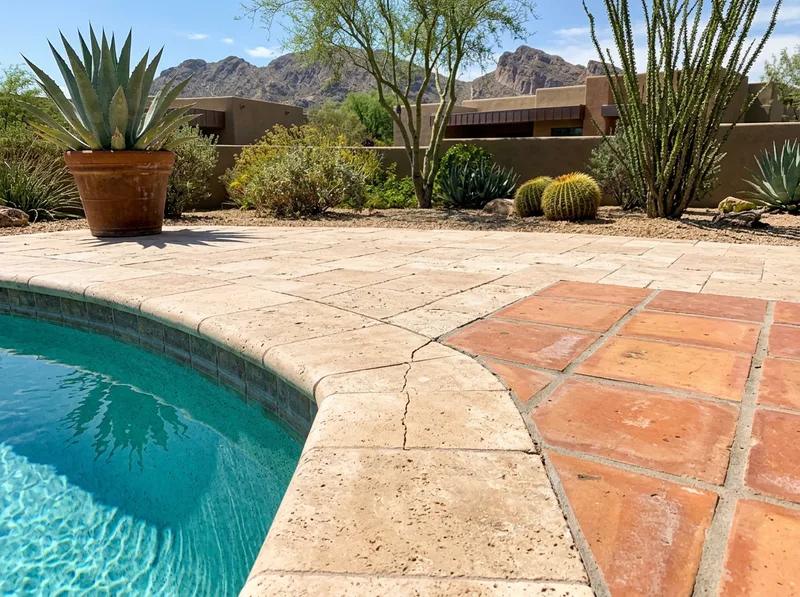
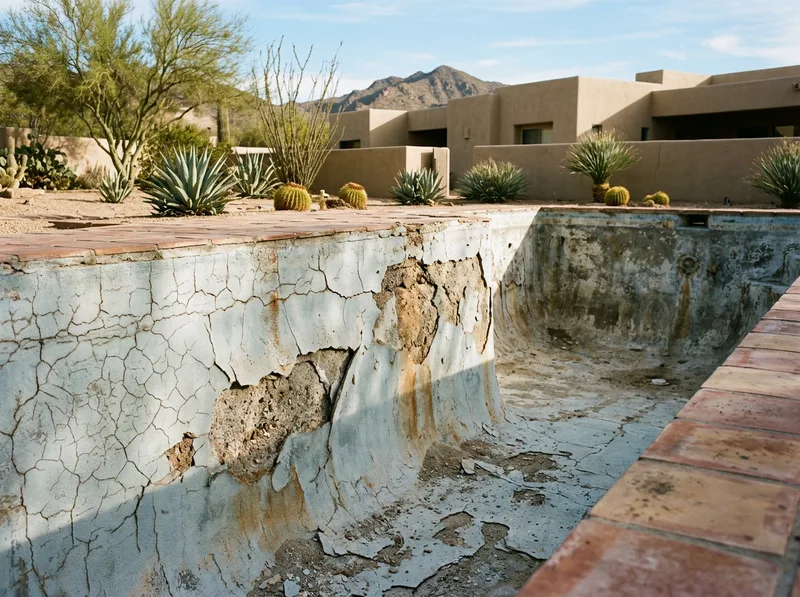
It works both ends. When the water runs hard, calcium comes out of solution onto the tile line, into the heater's heat exchanger and onto a salt cell's plates. When it runs softer and the balance is not adjusted for it, the water goes looking for calcium and takes it from the plaster — that is etching, and it roughens the surface, which then holds algae.
A pool that has been through both, repeatedly, over decades is the classic Tempe job: a surface that is rough in places and scaled in others, and equipment that has quietly been running at reduced efficiency for years. It is also why two Tempe pools of the same age can be in very different condition — the one whose owner adjusted with the seasons has had an easier forty years than the one on a fixed routine.
Heaters take this particularly badly, because scale on a heat exchanger is invisible until the heater starts failing safety cut-outs. Having the heater opened up and checked usually costs a fraction of replacing it, and tells you which of the two you are actually facing.
The pump pays for it too, because reduced flow through a scaled system makes the motor work harder for less, and a motor working harder for less in a Tempe August is a motor with a shortened life. The pump repair side of it is worth treating as a symptom of the scale rather than as a fault on its own.

Possibly not, and this is one of the few places where Tempe's age genuinely matters legally. A.R.S. §36-1681 requires a five-foot barrier, no opening a four-inch sphere can pass, and self-closing self-latching gates opening outward with a latch at least 54 inches up — for any contained water 18 inches or more deep and wider than 8 feet.
The statute then lists what it does not apply to, and that list includes any pool or barrier constructed before the article took effect, and any city that adopted its own ordinance that is equal to or more stringent. With a median build year of 1984, a lot of Tempe pools sit in exactly that territory.
Being exempt from the state minimum is not the same as being safe, and it is definitely not the same as being compliant with the city. It is also not permanent: rebuilding a barrier is generally the point at which the current rules start applying to it, which is worth knowing before you replace a fence rather than after.
Check with Tempe before you take a fence down for access, and before you drain. If a barrier is already down and the pool is open, that is emergency pool repair in Phoenix territory — mark it urgent rather than waiting for a slot.
On the city's own account of its water, yes — and this is the single most Tempe-specific thing on this page. The blend reaching the treatment plants changes with precipitation and snowmelt, and the two rivers behind it are chemically different from each other. A routine that was correct against one blend is, by definition, not correct against the other.
That does not mean anything exotic. It means testing rather than assuming, especially after a wet winter, when runoff shifts the mix most. The specific things worth re-checking are calcium hardness and total alkalinity, because those are the two that decide whether the water deposits calcium onto surfaces or strips it out of them. Chlorine and pH matter every week; those two matter every season.
The failure this prevents is the slow one. Nobody notices a pool scaling or etching in a month. They notice it after two or three years, at which point the surface is either rough or crusted and the fix is no longer a chemical one. On a pool with a median Tempe age of forty years, that surface has probably already been through the cycle more than once — so a small amount of seasonal attention is doing more work here than it would in a city with a stable supply.
If you have inherited a pool with a routine you did not set, this is the first thing worth re-examining. A schedule written by a previous owner against a different year's water is not evidence of anything.
It is also the reason to be careful with advice from elsewhere in the Valley, including from this site. Tempe's average of 12.3 grains is genuinely moderate and sits below Chandler's and Scottsdale's — but an average that spans 10.4 to 32.6 describes almost nobody's actual experience. Half of what makes Tempe pools distinctive is that the number people quote for the city is the least useful figure in the report.

Then the numbers are different enough to matter. Mesa's numbers run 12 to 22 grains depending on which supply reaches your street. Scottsdale's hardness bands are published by road — up to 25 grains south of Indian School Road, easing to 16 to 18 north of Chaparral.
Every city covered is listed here, each with the figures published by that city's own water utility.