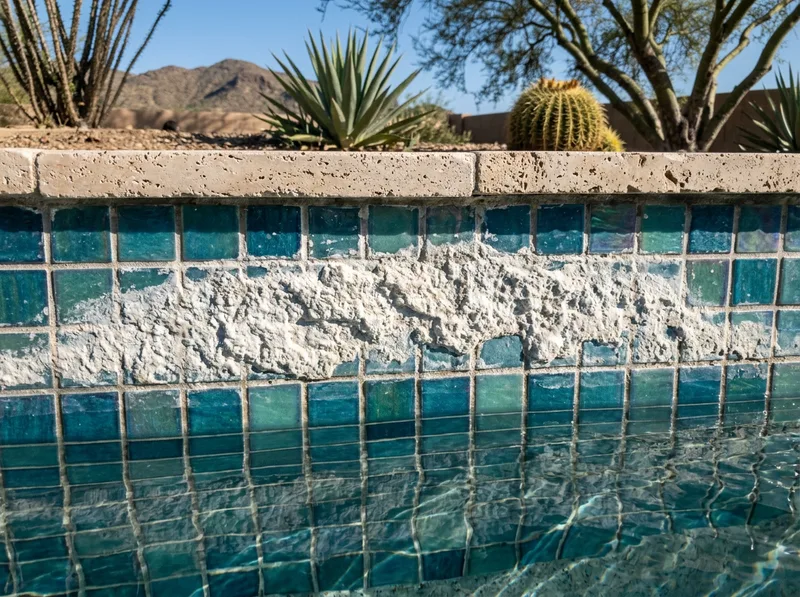
Gilbert is the outlier here twice over: the softest tap water of the six cities, and by some distance the newest housing.
We are a Phoenix pool repair referral service. Tell us what's wrong and we'll connect you with a local pool repair company.
Its own water quality report gives an average total hardness of 10 grains per gallon across a range of 6 to 13.5. Scottsdale's southern zone runs 22 to 25. That is a different pool-maintenance problem entirely.
The catch is age. A lot of Gilbert pools are arriving at the point where the first real bill lands. Tell us what yours is doing and we will connect you with a local pool repair company.
Prefer to talk? The number is (602) 833-7014. The form is quicker, and it is the only one of the two that reaches someone straight away.
Because of where it comes from. Gilbert runs two treatment plants on two different systems. The North Water Treatment Plant sits on the eastern canal and takes water from the Salt River Project — a blend of Salt River, Verde River and groundwater. The Santan Vista Water Treatment Plant takes Central Arizona Project water, which is Colorado River water carried down a 336-mile canal from Lake Havasu and then brought to the plant through about 14 miles of pipeline.
Santan Vista is built and operated in partnership with the City of Chandler, which uses 24 of its 48 million gallons per day. So two neighboring cities share a plant, and Gilbert still comes out softer overall, because the rest of Gilbert's supply is a different blend from the rest of Chandler's. It is a good illustration of why "East Valley water" is not one thing.
What this means for a pool owner is simple and slightly counterintuitive: softer fill water does not mean no calcium problem. It means calcium accumulates more slowly, so a Gilbert pool that has been neglected for five years may look better than a Scottsdale pool neglected for two, and still be storing up the same eventual bill.
It also means advice imported from elsewhere in the Valley can be wrong in the other direction. Water on the softer end of a range is more likely to be aggressive toward plaster if the balance is not maintained — it goes looking for calcium and takes it out of the surface. That is etching, and it is the failure mode Gilbert owners are more likely to meet than heavy scaling.
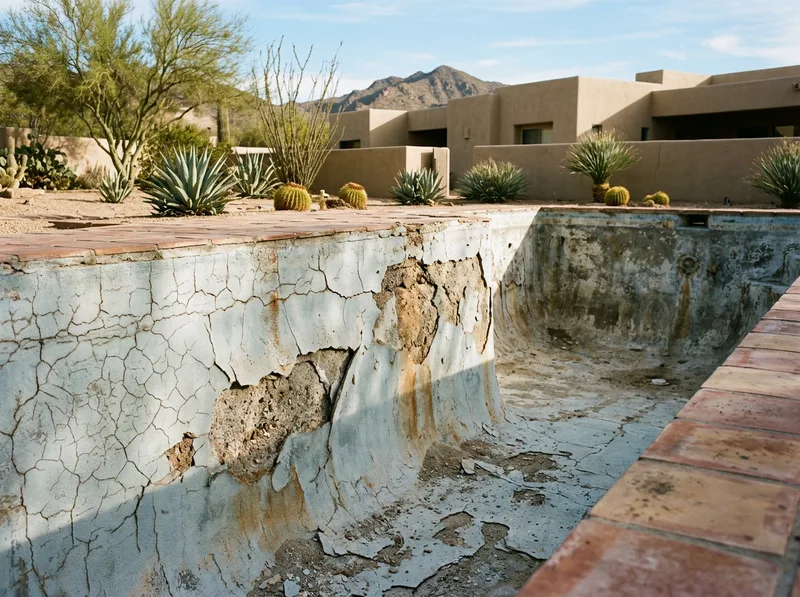
Because the town filled in fast and it filled in recently. The American Community Survey puts the median year a Gilbert home was built at 2003 — the newest of these six cities by six years, with Chandler next at 1997 and Phoenix furthest back at 1985.
A pool built with a 2003 house is now around twenty years old, and twenty is where several clocks run out together. Standard plaster does not survive indefinitely in Arizona conditions. Pumps have a finite life here. Heaters, salt cells, actuators and control boards all sit in the same window. So a large number of Gilbert pools are hitting their first serious spend at roughly the same time, and the owners have no prior experience of what that costs, because nothing had gone wrong before.
There is a timing consequence too. When a whole cohort of pools in one town needs the same work in the same few years, the local trade is busy in the same few years — which is felt as longer lead times in spring and summer, and as less room to negotiate. The practical response is to find out where your pool stands during the cool months rather than in June, when everyone else has just discovered the same thing about theirs.
That inexperience is the real risk, not the money. A first-time repair conversation is where people either over-buy — a full remodel when a resurface would do — or under-buy, replacing the one failed part on equipment that is all the same age. Neither is obvious from the deck.
The useful move is to find out which items are genuinely at end of life and which have years left. A full repair assessment is the version of that conversation that does not start with a catalog.
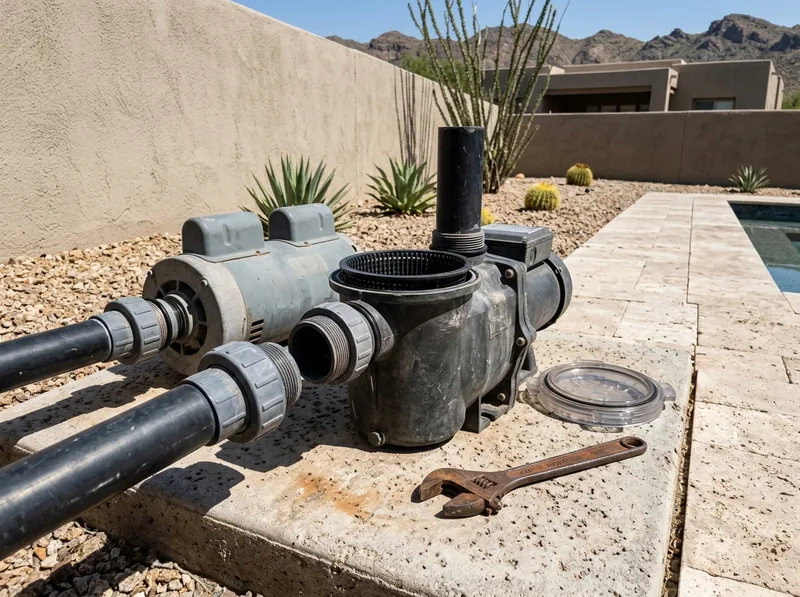
The pump, most often. A pool pump on its way out does not usually stop dead — it gets noisier, runs hotter, trips on the hottest afternoons and moves less water than it used to, so the pool gets harder to keep clear for reasons that look chemical and are not. Pool pump repair in Gilbert covers both the diagnosis and the decision about whether the motor is worth saving.
Second is the heater. A twenty-year-old heater on a pool that gets used through the winter has run a lot of hours, and Arizona heaters fail from the inside — scale, corrosion, a failed sensor — rather than in any way visible from outside. Whether it is worth repairing depends entirely on what has actually failed, which is why getting the heater looked at properly beats replacing it on principle.
Third, and most often left too long, is water loss. On a newer pool it is easy to assume a leak cannot be yours yet. Twenty-year-old plumbing, twenty-year-old skimmer throats and twenty years of ground movement say otherwise, and a pool with an autofill will hide it indefinitely. A proper leak search settles it in an afternoon.
Fourth, and worth knowing about before it happens: the surface. Twenty years is inside the window where a plaster finish starts to feel rough underfoot and stops responding to chemical treatment for staining. That is not an emergency, but it is the item most likely to turn a repair conversation into a much larger one, so it is worth knowing where yours stands.

We do not set prices — we are a referral service, and inventing a number would be worse than useless. What is on the public record is that a long-established Phoenix metro pool company, trading here since 1957, publishes resurfacing at $6,500 to $15,000 across the metro, full remodels at $15,000 to $65,000 or more, and a pump service life in Phoenix of 8 to 12 years.
The same company publishes that most plaster pools in Phoenix need resurfacing every 7 to 10 years, while an aggregate finish such as pebble lasts 15 to 20 — which, if it holds, is the single most relevant number for a Gilbert pool coming up on its first resurface decision. It is their figure, not ours, and it is worth asking anyone quoting you to stand behind their own version of it.
Those are metro figures, not Gilbert-specific ones. They are worth knowing before you get a quote so you can recognize an outlier when you see one. The actual number for your pool comes from someone who has looked at it.
The decision they point at is the one most Gilbert owners are about to face: whether to put standard plaster back or move to an aggregate finish. The honest way to read the published figures is as a cost-per-year question rather than a price question — a cheaper surface replaced more often is not automatically the cheaper option, and a more expensive one is not automatically the better buy if you are selling in three years. Ask whoever quotes you to put both numbers next to each other.
Two things are worth asking about at the same time, because they are cheapest while the pool is already drained: the tile line and any equipment that is close to end of life. Mobilization is a real cost, and doing a resurface now and a pump in eighteen months means paying it twice.

The state floor is A.R.S. §36-1681: a five-foot barrier, no gap a four-inch sphere passes, self-closing and self-latching gates opening outward with the latch at least 54 inches up, for any contained water 18 inches deep and wider than 8 feet.
The statute stands aside where a local government has adopted its own equal or stricter ordinance, and Gilbert is its own municipality. It also exempts pools and barriers built before the article took effect — but since almost every Gilbert pool postdates the statute, grandfathering is far less likely to help here than it is in Phoenix or Tempe.
Practically, that means assume the rule applies to you and check the town's version before you drain or move a fence for access. It is a five-minute question that is much cheaper asked in advance.
The other Gilbert-specific wrinkle is that a lot of these pools sit inside newer developments where a homeowners association has its own rules about fencing, gates and what may be visible from the street. Those are separate from the state statute and from the town's code, and they are not enforced by either. If your property is in one, the association's rules are a third document to check before work starts — and the one most likely to be overlooked, because nothing about a pool repair obviously involves it until a contractor turns up with a skip.
Neighboring cities, different numbers. The Chandler page covers a city that shares the Santan Vista plant with Gilbert and still averages 16.5 grains, because most of its supply comes from elsewhere. Mesa reports 12 to 22 grains depending on the street, on housing that is fourteen years older on average.
The other cities are here, and if something has failed and the pool cannot wait, flag it on the form so it goes out as emergency work rather than as a scheduled visit.