Scottsdale has the hardest pool water of any city on this site, and Scottsdale Water publishes the proof itself.
We are a Phoenix pool repair referral service. Tell us what's wrong and we'll connect you with a local pool repair company.
Its hard water fact sheet breaks the city into three bands: 22 to 25 grains per gallon south of Indian School Road, 20 to 22 between Indian School and Chaparral, and 16 to 18 north of Chaparral. In milligrams per liter that is 430 at the top end and 275 at the bottom.
That is not a small difference. Two Scottsdale pools on the same equipment, six miles apart, will not need the same maintenance. Tell us where yours is and what it is doing, and we will connect you with a local pool repair company.
Prefer to talk? The number is (602) 833-7014. The form is quicker, and it is the only one of the two that reaches someone straight away.
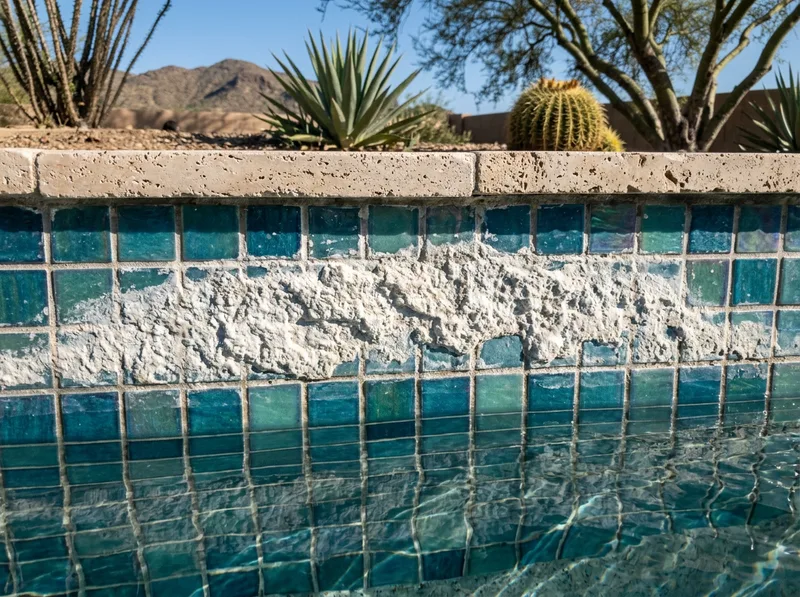
It deposits calcium, everywhere the water touches and everywhere it evaporates. The visible version is the crust along the tile line at the waterline. The expensive version is the part you cannot see.
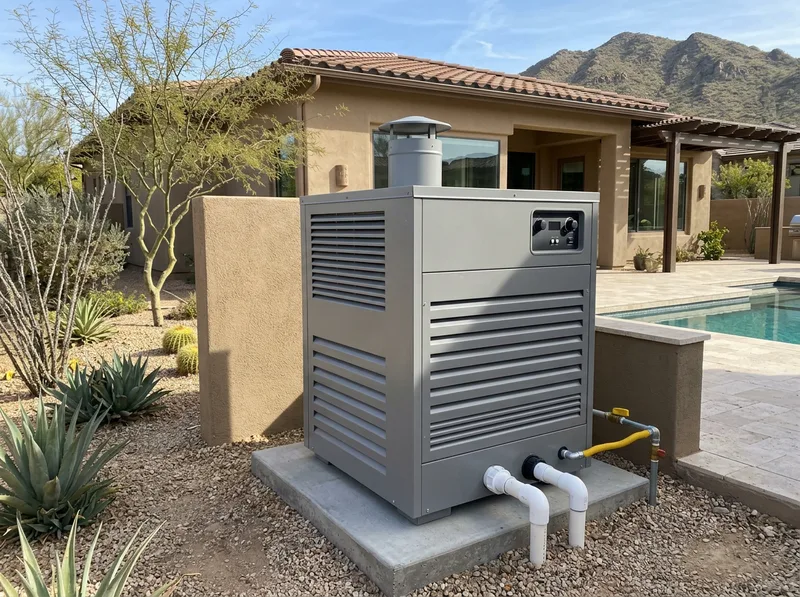
Inside a gas heater, scale forms on the heat exchanger. The burner keeps firing at the same rate but less of that heat reaches the water, so the heater runs longer for the same temperature, costs more to run, and eventually overheats components that were never meant to get that hot. It very rarely announces itself — it just gets slower and more expensive until something fails. Scale inside a heat exchanger is one of the few pool problems where the symptom and the cause look nothing alike.
Salt-chlorine cells suffer the same way. The plates scale, output drops, the controller reports low salt, and the obvious response — adding salt — makes nothing better. A cell that is scaled reads as a cell that is worn out, and plenty get replaced when they could have been cleaned.
The same is true of the automatic parts of the system that nobody thinks about. Actuators, check valves and the small internal passages inside a heater are all places where a slow calcium deposit changes behavior before it causes a fault. A valve that has become stiff, a heater that short-cycles, a cleaner that has lost suction — these read as three separate faults on three separate items, and in a 25-grain city they are quite often one cause with three symptoms.
Scottsdale Water also notes that around 70 percent of residential water use in the city is outdoors, which is a fair indication of how much water is passing through pools and evaporating here. Every gallon that evaporates leaves its minerals behind, so a pool in a hot Scottsdale summer is concentrating hardness even when nothing is being added to it.
The southern end. Scottsdale Water's own boundary table puts the 22 to 25 grain band south of Indian School Road, which covers Old Town and south Scottsdale. Between Indian School and Chaparral it eases to 20 to 22. North of Chaparral it drops to 16 to 18 — still hard by national standards, but meaningfully softer than downtown.
The city explains why plainly: it treats water from multiple surface and groundwater sources, and hardness varies with the source and the treatment process. It also says it does not treat for hardness, on the grounds that doing so would not be cost effective given how much of the city's water goes outdoors.
So a Scottsdale pool owner has no municipal fix coming, and no reason to expect one. Managing calcium is a maintenance problem and, when it has been left, a repair problem. The compounding effect is what makes the southern bands expensive: at 25 grains a pool reaches the point of needing intervention in roughly two-thirds the time it would north of Chaparral, on identical care.
It is also worth knowing that the bands are boundaries on a map, not a gradient. A pool a block south of Indian School Road and a pool a block north of it are, on the city's own published figures, on different water — which is a strange thing to be true and is exactly the kind of detail that makes generic advice unreliable here. If a neighbour's pool behaves differently from yours on identical equipment and identical care, the boundary is the first thing to check rather than the last.
Knowing which band you are in is genuinely useful before you spend anything. It changes how often a salt cell should be inspected, how aggressively the water needs balancing, and whether a heater is worth descaling or has been running scaled for years. The diagnostic work that comes first covers most of what that turns into.
In the middle. The American Community Survey puts the median Scottsdale home at 1991 — newer than Phoenix, Tempe and Mesa, older than Chandler and Gilbert. Median home value is $789,800, the highest of the six by a wide margin.
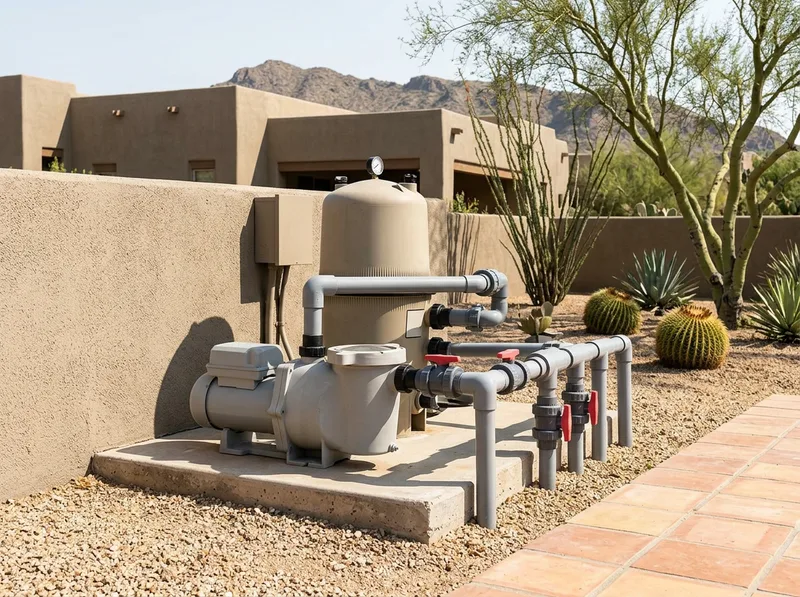
Those two facts together describe the typical job here reasonably well: a pool in its thirties, often with equipment that has been upgraded at least once, on a property where the owner would rather fix it properly than patch it. Pool equipment on a 1991 build is usually on its third generation by now, which means a mix of eras — a modern variable-speed pump plumbed into 1990s pipework, or a new heater sitting on an old gas line.
Mixed-era equipment is where diagnostics earn their money, because the fault is often the join rather than the part. A new pump moving water through undersized thirty-year-old plumbing will not deliver what its label says, and will fail early trying. A control system retrofitted onto older equipment can report a fault that belongs to the retrofit rather than the equipment.
If the pump is the thing that stopped, pump and motor work is the place to start — but it is worth asking what the pump was fighting before it stopped.

In Scottsdale, that question is harder than it sounds, because hard water and heat both push you toward the wrong answer. Summer evaporation is genuinely high, so a real leak hides inside it. And calcium works both ways: it can slowly seal a hairline crack, which makes a leak intermittent and easy to dismiss, then reopen it.
An autofill makes it worse, because it removes the only symptom you would have noticed. A pool with an autofill can leak for a year without the level ever visibly dropping — the water bill goes up, the chemistry gets strange because it is being diluted constantly, and nothing looks wrong.
The honest test is a bucket test before anything else, and it costs nothing: float a filled bucket on a step, mark the level inside and out, turn the autofill off, and compare after a day. If the pool has lost more than the bucket, it is a leak.
After that it is equipment. A leak search uses pressure testing, listening gear and dye — it is not guesswork, and it is not something a maintenance visit does incidentally. Finding out where the water is actually going is its own job with a definite answer at the end of it.
It moves the break-even point. On soft water, a lot of pool maintenance is optional in the sense that skipping it for a season costs you nothing you notice. At 22 to 25 grains it is not optional, because the cost of skipping it compounds into components rather than into water clarity.
Two things are worth doing on a Scottsdale schedule rather than a national one. Inspecting a salt cell for scale, because a scaled cell quietly under-produces and gets blamed on salt level. And keeping an eye on the heater's run time, because a slow heater is the only early warning a scaled heat exchanger gives.
The third is the waterline tile, which is the one people leave because it is cosmetic. It is cosmetic right up until the calcium has to be removed by bead-blasting rather than by cleaning, at which point it is a job with scaffolding and a drained pool.
There is a fourth that only applies at this end of the hardness range: what happens when a pool is left over a long absence. A Scottsdale pool that sits unattended through a summer — a rental between tenants, a second home, a probate property — is not in the same condition afterwards as one left in a softer city. Evaporation concentrates what is already the hardest supply on this list, and the result is a surface and an equipment pad that have both been sitting in over-concentrated water for months.
None of this is unique advice — it is the same advice everywhere. What is different in Scottsdale is the timescale, and the timescale is what turns maintenance into repair. If something has already gone that far, say so and it is treated as an urgent job.

The numbers change city by city, so use the right page. Phoenix sits on softer water than south Scottsdale and has much older housing stock. Chandler is stranger still — the city itself reports a range from 5 grains to 20 depending on which of its three supplies reaches your street.
All six cities are listed here, each with the figures that city publishes for itself rather than a Valley-wide average that fits nobody in particular.