What actually breaks on a Phoenix pool?
Phoenix pools fail in a pattern, and the pattern is driven by two things that are not true of pools in most of the country: extremely hard water and relentless sun. A long-established Phoenix pool company puts local pool calcium hardness at 300 to 350 ppm and cites more than 300 days of UV exposure a year. Between them, those two facts explain most of the repair calls in the Valley.
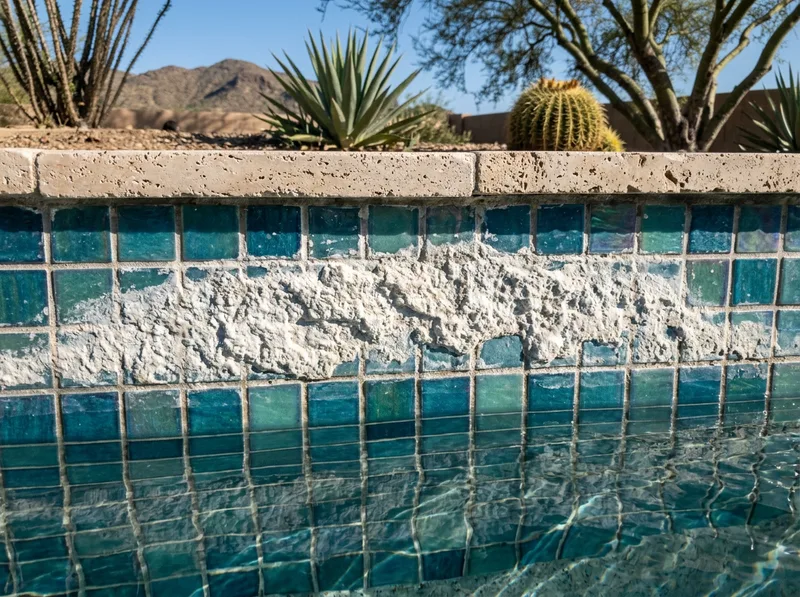
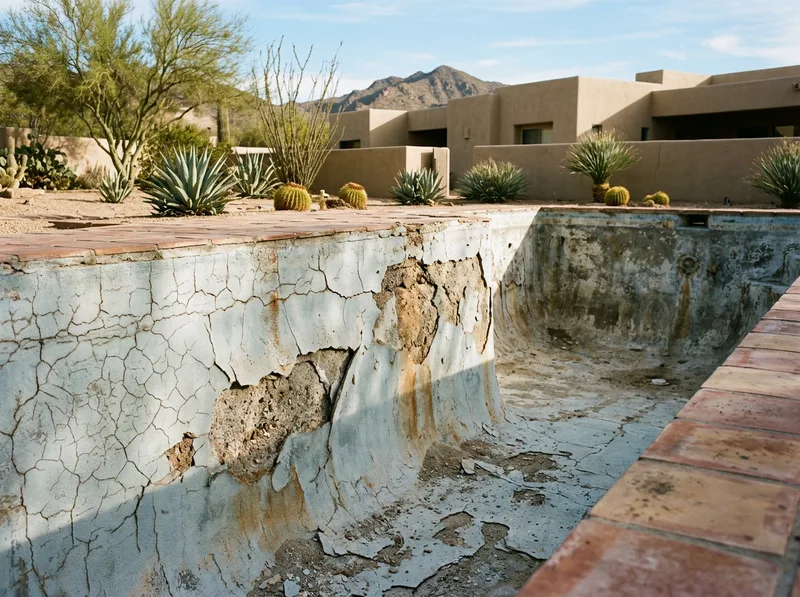
Hard water leaves scale. Scale settles where water is hottest or moves fastest — inside heat exchangers, on salt cell plates, on seals and on the waterline tile. Sun and heat attack everything else: the plastic lid on the pump, the o-ring under it, the pool surface, the wiring insulation, the filter housing. A part rated on national averages does not get its rated life here, which is the single most useful thing to understand before you read anyone’s quote.
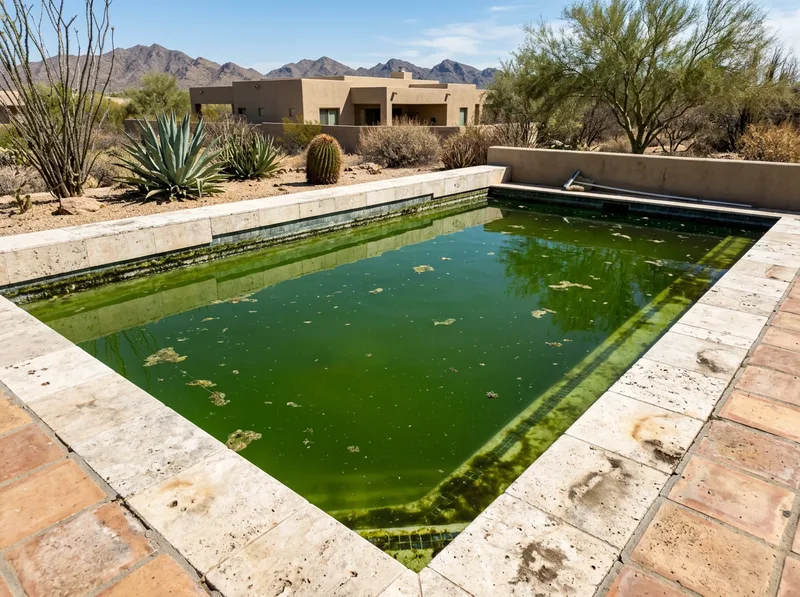
In rough order of how often they come up, the repairs are: pumps and motors, leaks, heaters, filters, salt cells, and pool surfaces. Green water is almost never a repair in its own right — it is a symptom that one of those six has quietly stopped working, usually the pump or the filter.
How do I work out what is wrong before I call a Phoenix pool company?
You do not have to diagnose it. But five minutes of looking will make your quote far more accurate, and it protects you from paying for a callout to find out something you could have established yourself.
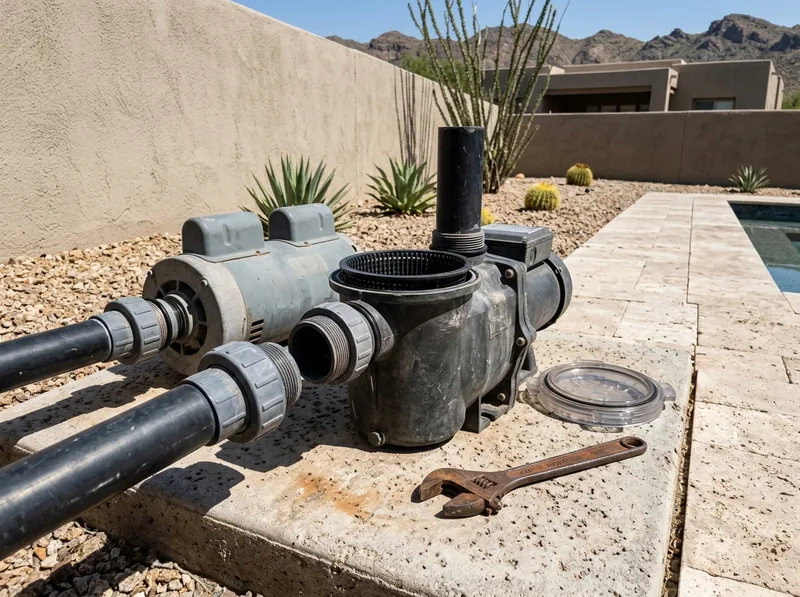
Start with the pump. Is it running at all? A pump that hums but does not turn, smells hot, or trips the breaker is an electrical problem. A pump that runs but moves little water, has air in the basket, or drips between its two halves is a plumbing problem. Those are different jobs at different prices, and the distinction is covered properly on our pool pump repair page.
Then look at the water level. If it is dropping faster than it used to, the question is whether that is evaporation or a leak — and there is a free test that settles it in two days, which we walk through on the leak detection page. Do that before you pay anyone to look, because the answer changes who you need.
Then check the heater, if you have one. A heater that fires and shuts off again within minutes is usually protecting itself from low water flow or a scaled exchanger rather than failing outright, and pool heater faults are the ones where an early call genuinely saves money.
Finally, decide whether it can wait. Most pool problems can. Electrical faults, gas smells and fast water loss cannot, and there is a short list of things to do in the first ten minutes that is worth reading before you need it.
What does pool repair cost in Phoenix?
We have no signed contractor, so we have no prices of our own and we will not invent one. What we can give you is the market context, so you can tell a normal quote from an odd one.
Read those as a sanity check rather than a quote. They tell you that a $2,000 pump job is at the top of the normal range but not absurd, and that a $9,000 quote for a pump is not a Phoenix price. What they cannot tell you is what your pool needs, because nobody can do that from a website.
One structural thing worth knowing before you compare quotes: on heaters and pumps, the manufacturer warranty often depends on who installed it. The same company states that a pump bought online may carry only a 90-day warranty against a multi-year factory warranty when supplied and fitted by a pool professional. On equipment that lives outdoors in Phoenix heat, that gap is worth real money, and it means the cheapest quote is not automatically the cheapest outcome.
Which repairs are urgent in Phoenix, and which can wait?
Three things genuinely cannot wait. Anything electrical — a breaker that will not stay on, a burning smell at the equipment pad, or a shock from any part of the pool system. Anything involving the smell of gas near a heater, which is a call to your gas utility before it is a call to a pool company. And fast water loss, meaning inches a day rather than a fraction of an inch, because water escaping under a pool can undermine the shell and the deck.
Almost everything else can wait a few days without getting worse, and paying an out-of-hours premium for it is money you do not need to spend. A dead heater in October, a noisy pump, a green pool, a torn filter element — all annoying, none of them emergencies.
There is one exception worth naming, because it is the one that costs people money. A pump that has been run dry, or run with air in it, gets worse every hour it stays on. If the water level is near the skimmer or the pump is screaming, switch it off. It is not going to fix itself and it is a bigger repair tomorrow.
Is repairing old pool equipment worth it in Phoenix?
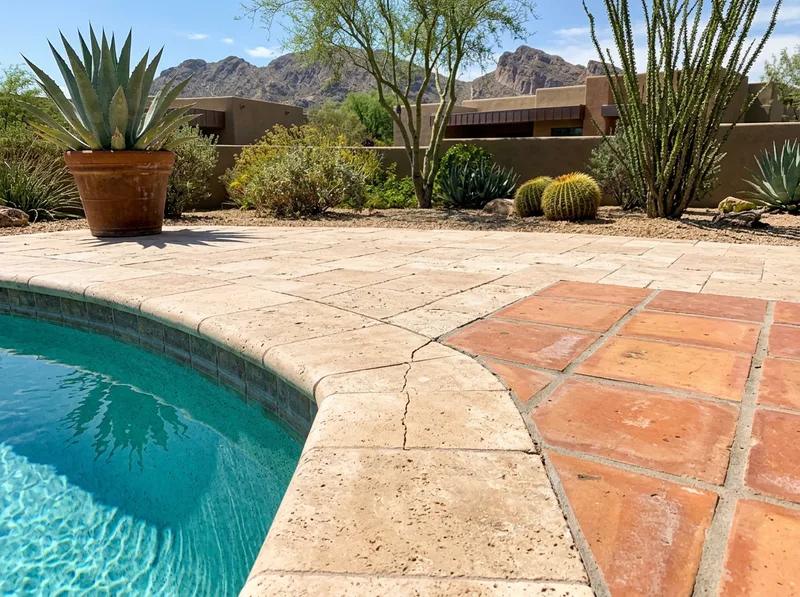
The honest test is what the repair costs against how much life the equipment has left, and in Phoenix that second number is shorter than the national one.
A long-established Phoenix pool company publishes 8 to 12 years for pool pumps locally, 7 to 12 years for gas heaters and 10 to 15 for heat pump heaters. It also puts standard plaster at 5 to 7 years before it stains and roughens, against 15 to 20 years for a pebble finish. Those numbers are theirs, not ours, but they are a reasonable frame: a $600 repair on a nine-year-old pump is a different decision from the same repair on a three-year-old one.
Pumps carry an extra argument that the other equipment does not, because they run for hours every day. SRP describes the pool pump as “likely the second-largest electricity user in your household”, and ENERGY STAR puts the same point in dollars: a pool pump “could be your home’s second largest energy user, costing you as much as $310 in energy every year”. A variable-speed pump changes that, and the reason is arithmetic rather than marketing — ENERGY STAR states that “reducing pump speed by one-half allows the pump to use just one-eighth as much energy”. So when a single-speed pump near the end of its life needs an expensive part, the running cost of keeping it usually decides the question before the repair bill does.
What can Phoenix pool owners do that costs nothing?
Three things, all of them recommended by the local utilities rather than by anyone selling you a repair.
Run the pump on a schedule. SRP’s guidance is eight to 12 hours a day in summer and six to eight in winter, on a timer, and during off-peak hours if you are on a time-of-day plan. APS is more specific for winter — run it during super off-peak hours from 10am to 3pm — and puts the saving at up to $120 a year for a customer on a time-of-use plan. That is scheduling, not equipment. It costs nothing.
Keep the filter clean instead of backwashing on a habit. AMWUA notes backwashing can use anywhere from 250 to 1,000 gallons of water, so doing it only when the pressure says to is worth real money in a Phoenix summer.
And use a cover. SRP states a conventional or liquid pool cover can reduce evaporation by 40 to 50 percent. In a climate where AMWUA reports outdoor water use can make up as much as half of a household’s water bill in the hottest months, that is the highest-return thing on this list.
How do I get a pool repair quote in Phoenix through this site?
You fill in the form. We read it, and pass your details to a local pool repair company that covers your part of the Valley. They contact you directly, ask whatever they need to ask, and quote you. You deal with them from that point on. We are not a party to the work, we do not mark up the repair, and we do not take a cut of your bill.
We cover Phoenix itself along with Scottsdale, Mesa, Gilbert, Tempe and Chandler — the full list is on the service areas page, and there is a dedicated page for pool repair in Phoenix itself. If your pool is elsewhere in the Valley, send the inquiry anyway and say where you are. We would rather tell you we cannot help than pretend to cover every suburb in Maricopa County.
If you would rather talk it through first, the number is (602) 833-7014, or you can send a message from the contact page. Send us a message any time.