What actually fails on a Phoenix pool heater?
Pool heaters come in two families and they fail in different ways, so the first useful question is which one you own.
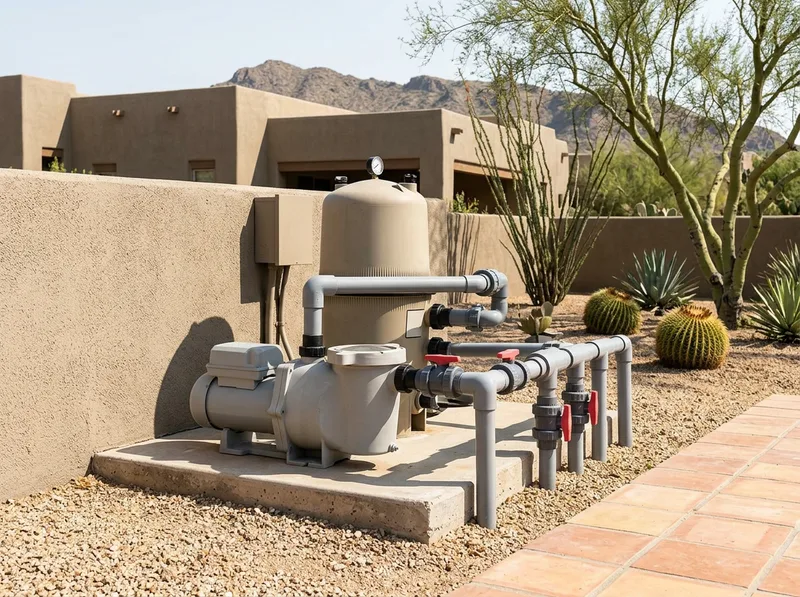
A gas heater burns natural gas or propane to heat water flowing through a heat exchanger. It heats fast and does not much care what the outside air is doing. Its failures cluster around combustion and around the exchanger: igniters and pilot assemblies, gas valves, pressure switches, high-limit switches, control boards, corroded or scaled heat exchangers, and burner trays that have been sitting outdoors for a decade.
A heat pump heater does not burn anything. It moves heat out of the outside air into the pool water, the same way an air conditioner works in reverse. Its failures look like air-conditioning failures: refrigerant loss, compressor and capacitor faults, fan motors, reversing valves, and evaporator coils clogged with dust — which, in a Phoenix yard, is a real maintenance item and not a theoretical one.
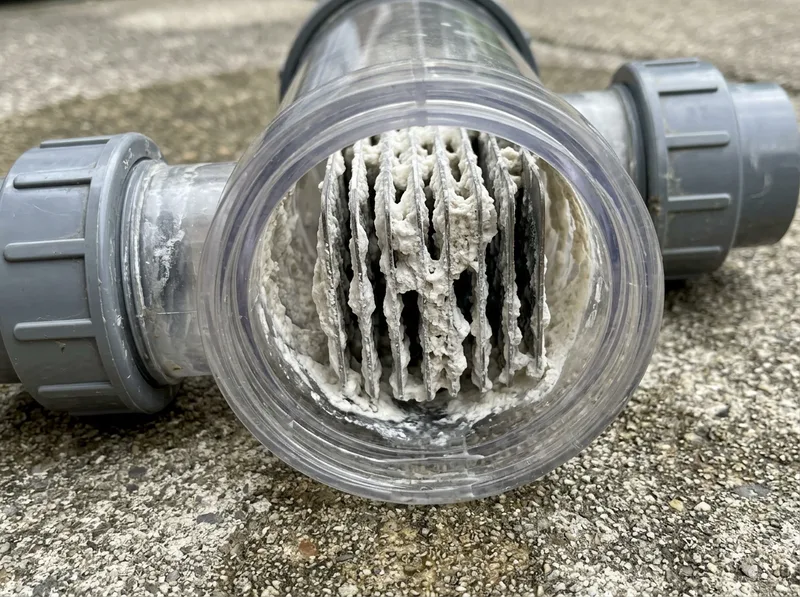
Both families share the same weak point: the heat exchanger, and what Phoenix water leaves inside it.
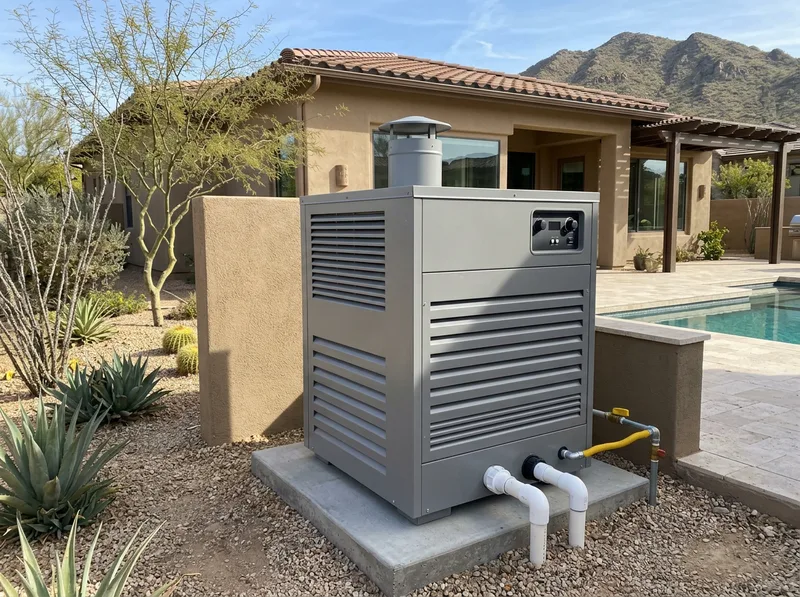
Why hard water is the main enemy of Phoenix pool heaters
A heat exchanger is the only place in your pool system where hard water meets a genuinely hot surface. That is exactly the condition under which dissolved calcium comes out of solution and sticks.
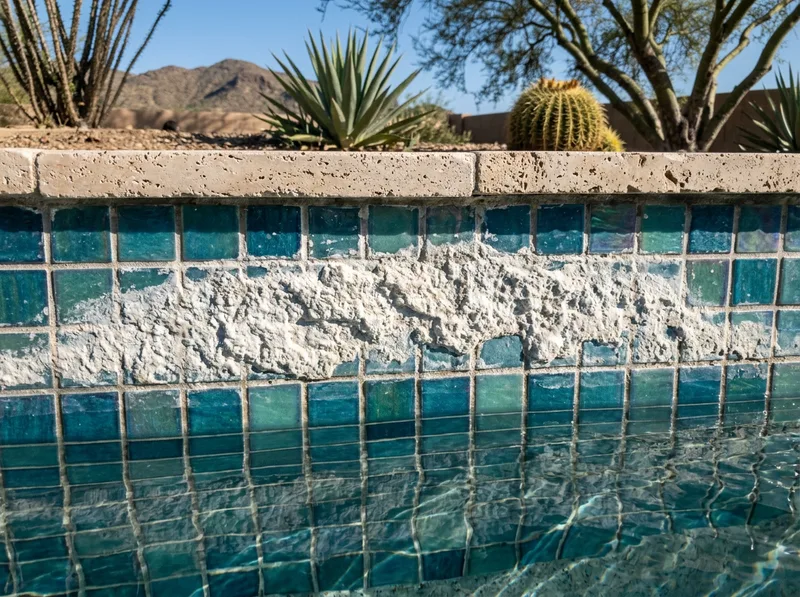
A long-established Phoenix pool company puts local pool calcium hardness at 300 to 350 ppm and states that it “accelerates scale buildup inside heat exchangers”. That figure is higher than the tap water it came from, and the reason is simple: evaporation removes water and leaves minerals behind, so a Phoenix pool concentrates its own hardness over a season. It is a slow, one-way process, and it is why pool chemistry in the Valley needs managing rather than ignoring.
Scale is an insulator sitting on the wrong side of the metal. The heater has to run hotter and longer to push the same heat into the water, which costs gas or electricity, raises the metal temperature, and shortens the exchanger’s life. Left long enough it restricts flow, which trips the heater’s own safety switches — the short-cycling described further down this page.
The same company publishes that annual descaling extends heater life by 3 to 5 years. On a component this expensive, that is the highest-return maintenance item on the pad, and it is the reason to book a service before the first cold week rather than during it.
Salt pools have a sharper version of the same problem. That company puts standard copper heat exchangers at 6 to 8 years and cupronickel at 12 to 15, and states that cupronickel is required with a salt water system, because salt and low pH corrode copper quickly. If you have a salt pool and you are replacing an exchanger or a heater, that is a specification question worth asking about explicitly.
Gas heater or heat pump — which makes sense in Phoenix?
They answer different questions, and the right choice depends on how you use the pool rather than on which is better.
A gas heater is for people who heat the pool occasionally. It brings water up quickly, so you can decide on Friday that you want a warm pool on Saturday. It costs more per hour to run, but you run it rarely.
A heat pump is for people who want the pool at a steady temperature for months. A long-established Phoenix pool company publishes heating rates of 1 to 2 degrees per hour for heat pumps — slow — and states they cost 50 to 80 percent less to operate than gas. You leave it on and it holds temperature cheaply.
The Phoenix-specific part is air temperature. That company notes heat pumps work well here from March through November because local air temperatures stay above 50 degrees for most of the year. That 50-degree threshold is a heat pump constraint, not a gas one — a heat pump has less heat available to move as the air gets colder, so its output and efficiency fall away in a cold snap. A gas heater is largely indifferent to the air temperature. If you specifically want a warm pool in January, that difference is the whole decision.
How long should a pool heater last in Phoenix?
A long-established Phoenix pool company publishes 7 to 12 years for gas pool heaters in Arizona and 10 to 15 years for heat pump heaters, attributing the heat pump’s longer life to having fewer combustion components. Those are their figures, not ours.
Use them for the repair-or-replace decision, together with which part failed — which matters more than the age on its own. Igniters, gas valves, pressure switches, control boards and fan motors are serviceable parts, and replacing one on an otherwise sound heater is normal maintenance. A corroded or split heat exchanger is different: it is the expensive component, and on a heater already near those ages its failure usually means the rest of the unit has lived the same life in the same water.
So the two questions to put to whoever quotes you are: how old is this unit, and which part has failed. Make the decision from those, not from the repair price in isolation.
Why does my pool heater keep shutting off?
Short-cycling — firing, running briefly, shutting down, repeating — almost always means the heater is protecting itself rather than failing outright. The causes, roughly in the order worth checking:
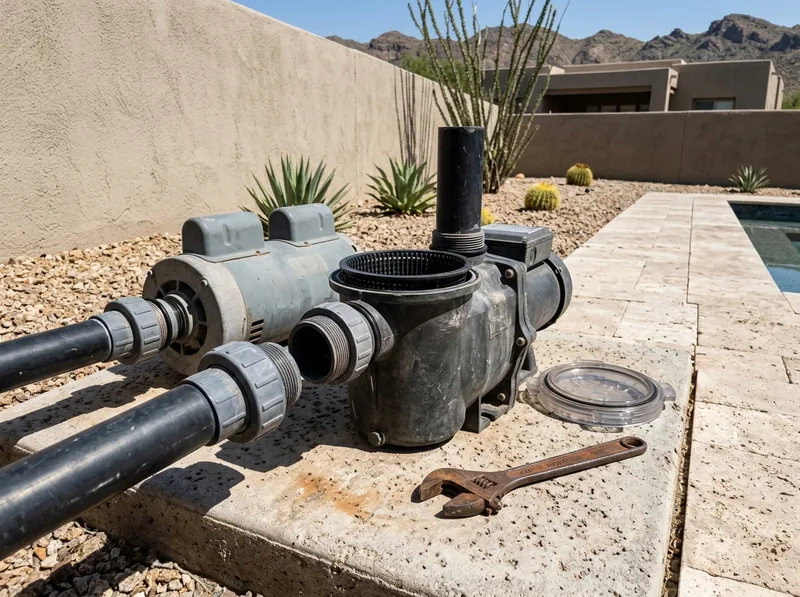
- Low water flow. A dirty filter, a partly closed valve, a blocked pump basket or a failing pump. The heater needs a minimum flow to carry heat away from the exchanger and it will shut down without it.
- A scaled heat exchanger. Same symptom by a different route — the heat cannot get into the water fast enough, so the metal overheats and the high-limit switch trips.
- A faulty high-limit or pressure switch. The safety device itself has failed and is reporting a problem that is not there.
- Restricted exhaust or airflow. On a gas unit, a blocked flue. On a heat pump, an evaporator coil packed with dust and debris.
Flow is worth ruling out first because it is free. Clean the filter, confirm every valve is open, check the pump basket, and see whether the behavior changes. If the pump is also noisy, losing prime, or has been running with air in it, the heater is the symptom and the pump is the actual fault. If nothing changes, it needs someone with gauges rather than more guessing.
One thing not to do: repeatedly reset a heater that keeps locking out. The lockout is the last line of defense on a device that burns gas, and forcing it past that is how a manageable repair becomes a dangerous one. If you smell gas near the heater at any point, stop — that belongs on the emergency list, and the first call is to your gas utility.
Should I buy the heater myself and have someone fit it?
You can, and on a heater it is the decision most likely to cost you money later. Check the warranty terms of the exact model on the manufacturer’s own site before you buy on price.
A long-established Phoenix pool company states that every major pool heater manufacturer requires professional installation to honor the full factory warranty; that one manufacturer voids the warranty entirely without proof of professional installation; and that another sells exclusively through authorized pool professionals and provides zero manufacturer warranty on equipment bought through any internet retailer. They also cite a five-year heat exchanger warranty on one model when professionally installed.
We have not independently verified each manufacturer’s current terms, so treat the specifics as a prompt to check rather than as settled fact. But the shape of it is consistent across the industry, and the component most likely to fail on a Phoenix heater — the heat exchanger — is precisely the one those warranties cover. Saving a few hundred dollars on the purchase to lose multi-year cover on the expensive part is a poor trade in this water.
When should a Phoenix pool heater be switched off?
In summer, according to APS, which lists “Turn off your pool heater in the summer” in its own appliance-by-appliance savings guidance. In a Phoenix July the pool does not need help getting warm, and a heater left enabled can cycle for no benefit at all.
There is a water argument alongside the energy one. AMWUA notes that lowering your pool temperature cuts evaporation, saving water and energy together, and that cooling pumps can bring pool temperature down by as much as 15 degrees. SRP adds that a conventional or liquid pool cover can reduce evaporation by 40 to 50 percent — a cover works in both directions, holding heat in during the cool months and cutting loss during the hot ones.
What should I send you about the heater?
Make, model and rough age; whether it is gas or a heat pump; what it does when it tries to fire; any error code on the display; and whether it has ever been descaled. Error codes in particular are worth copying exactly — they turn a diagnostic visit into a parts visit.
Also mention anything odd about the water level, because a heater fed by a pump that is losing prime will misbehave for reasons that have nothing to do with the heater. The free test on our leak detection page rules that in or out in two days. For the wider picture of Phoenix pool repair costs and what else tends to fail, start from the main pool repair page.
We cover Phoenix, Scottsdale, Gilbert, Mesa, Tempe and Chandler — see the service areas page for the full list. Call (602) 833-7014 or send a message. Send us a message any time.